


 Trump Doubts Iran Mining Reports as Strait of Hormuz Tensions Escalate
  Trump Administration Launches Trade Investigations Against 16 Countries Over Industrial Overcapacity
  Taiwan's MQ-9B SkyGuardian Drone Order Stays on Schedule Despite Middle East Conflict
  U.S. and Russia Hold Diplomatic Talks in Florida Amid Ongoing Tensions
  Trump Administration Spent $5.6 Billion in Munitions in Opening Days of Iran Strikes
  Pentagon Taps Wall Street Talent to Manage $200 Billion Defense Investment Fund
  U.S. Calls for Reassessment of International Aid to Taliban-Ruled Afghanistan
  Trump-Putin Call Addresses Iran War, Ukraine Peace, and Global Oil Crisis
  Iran's Government Remains Stable Despite U.S. and Israeli Strikes, Intelligence Shows
  Trump Hints at Possible U.S. Takeover of Cuba Amid Deepening Humanitarian Crisis
  Venezuela Names Paula Henao as New Oil Minister Amid U.S.-Led Industry Overhaul
  Japan's BOJ Independence Under Fire as PM Takaichi's Rate Stance Draws Political Heat
  Iran Mines Strait of Hormuz: Crude Oil Prices Surge Amid Middle East Tensions
  U.S.-Israel War on Iran Sends Crude Oil Prices Surging Amid Strait of Hormuz Tensions
  U.S. Senate Greenlights AI Chatbots for Official Staff Use
  Boeing Secures $289 Million Smart Bomb Contract With Israel


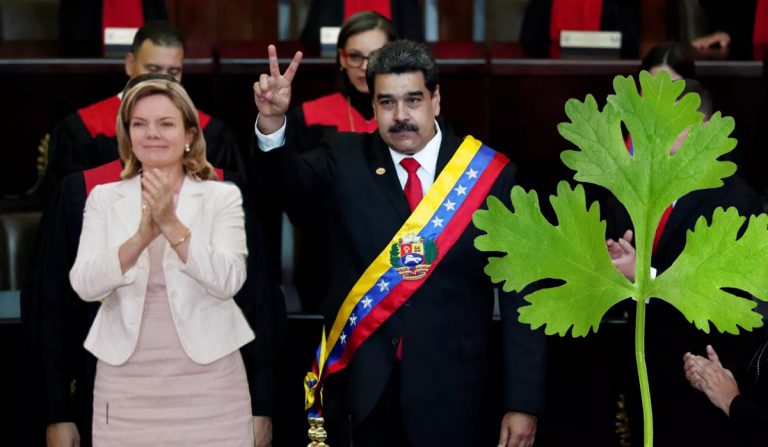
The reported U.S. capture of Venezuelan leader Nicolas Maduro has triggered major political uncertainty in the oil-rich nation, raising urgent questions about who truly controls the government. U.S. President Donald Trump praised the operation as “stunning and powerful,” claiming that Vice President Delcy Rodríguez had been sworn in and even held talks with U.S. Secretary of State Marco Rubio. Under Venezuela’s constitution, Rodríguez would become acting president in Maduro’s absence, and the country’s top court initially ordered her to assume that role.
However, the situation quickly became more complex. Rodríguez appeared on state television alongside key power brokers, including her brother Jorge Rodríguez, Interior Minister Diosdado Cabello, and Defense Minister Vladimir Padrino López, declaring that Maduro remained Venezuela’s only president. The unified appearance suggested that the inner circle that has governed Venezuela for more than a decade is attempting to project stability despite Maduro’s capture.
Analysts note that removing Maduro does not automatically dismantle Venezuela’s entrenched power structure. Real authority has long rested with a small civilian-military elite sustained by patronage networks, corruption, and powerful security agencies. Rodríguez and her brother represent the civilian wing, while Cabello and Padrino embody the military side, creating a delicate balance that complicates any transition.
Diosdado Cabello has emerged as a central figure to watch. Widely viewed as the most ideological and hardline actor within the regime, Cabello wields influence over military and civilian intelligence services accused by the United Nations of crimes against humanity. His recent public statements, including calls to hunt down “terrorists,” underscore fears of intensified repression during this uncertain period.
Venezuela’s military leadership also plays a critical economic role. Hundreds of generals control key sectors such as food distribution, raw materials, and the state oil company PDVSA, while also benefiting from illicit trade routes. Despite reports that some officials are seeking to defect and negotiate with the United States, sources indicate Cabello remains unwilling to cut a deal.
As Venezuela enters a volatile new phase, the struggle among its entrenched elites will likely determine whether Maduro’s capture leads to real change or simply a reshuffling of power.













