


 US Tech Giants’ AI Bond Boom Raises Euro Zone Borrowing Risks
  SK Hynix Shares Fall as Workers Reject Wage Deal
  Faraday Future Delivers First Robots in Middle East, Plans September Launches
  PayPal Shares Sink as $50 Billion Takeover Bid Collapses
  Lenovo Shares Fall After Dropbox Security Breach Exposes ID Vulnerability
  SoftBank Eyes $20 Billion Bond Sale to Refinance OpenAI Loan
  BofA Names ASML Top Semiconductor Equipment Pick on Growth, Valuation
  U.S. Probes Apex Logistics Over Nvidia AI Chip Shipments to China
  Salesforce Shares Surge as AI Demand Powers Q2 Earnings Beat
  MongoDB Stock Sinks 14% as Atlas Growth Misses Expectations
  Luxshare Shares Rise as First-Half Profit Jumps 18%
  OpenAI Nears Astra AI Model Launch With Safety Focus
  Nvidia Pauses AI Cloud Financing Deals Amid Antitrust Concerns
  Apple’s Phil Schiller Steps Back as Leadership Shake-Up Accelerates
  SpaceX Mobile Network Could Cost Up to $130 Billion, Bernstein Says
  Meta, U.S. States Discuss Settlement in Teen Addiction Trial


 Add as a preferred source on Google





Buried in a dusty landfill in Alamogordo, New Mexico, are more than 700,000 discarded Atari game cartridges, including E.T., the 1982 Atari game based on the blockbuster film. This bleak trove of artifacts symbolizes the video game crash of 1983, when consumer demand plummeted and companies like Atari literally dumped their cartridges in the trash.
Why did the popularity of Atari video games rise exponentially only to collapse seemingly overnight? As soon as creative original Atari games like Centipede and Space Invaders hit store shelves, many, many imitations flooded the market.
Lucrative ideas are often copied and replicated to capitalize on successes by the company that created the original, and by imitators. There are, for example, more than 20 movie sequels to Marvel’s “Avengers” and “X-Men.”
When Atari games were growing in popularity in the early 1980s, entrepreneurs jumped in, copying and modifying the computer code to create knockoffs such as Phobos, Pushky, Quarxon, Yahtman, Catterpiggle and Diggerbonk. As copycats copied the original and then copied the copies, the initial coders who created pioneering Atari games, including Pong, Combat and Super Breakout, were no longer directly involved. Their creativity and innovation were diluted by the sheer number of game designers copying one another.

Based on an arcade game, Pac-Man was one of Atari’s most popular releases, selling more than 8 million copies. Giorgio Trovato for Unsplash.com, CC BY
Our international team of researchers studies this phenomenon and calls it the “dilution of expertise.” In a recently published study we examined how replication and imitation affect a product by asking: Were there measurable warning signs before the collapse of a multimillion-dollar market as Atari saw? We believe that the results of this research could be beneficial to investors and consumers to better understand the trends and cycles of creative products.
Boom-and-bust cycles
Our team tackled this issue using our collective expertise in network theory, anthropology, cultural evolution and evolutionary biology. We reviewed three case studies of creative products that had experienced distinct phases: explosive growth and collapse.
The case studies included Atari games from 1979 to 1991, cryptocurrencies from 2015 to 2020 and Reddit posts, an online network of communities, from 2018 to 2019. Each of these examples had undergone a “boom and bust” cycle beginning with a rapid rise and ending with a sudden decline. All were characterized by significant numbers of knockoff products that competed for consumer attention and money, inundated the market and effectively diluted the pioneering expertise.
Knockoffs are particularly easy to do with both words and code, because slight changes in text or computer code can count as a new version of a product.
Reddit posts, for instance, are typically short messages written in English, which very often copy previous posts with minor alterations. Atari games are a collection of 8-bit machine code sequences that were shared among programmers within the company and could also be copied, or reverse-engineered, by other companies. Cryptocurrency white papers are widely available documents written in English containing technical information about the currency and the business itself.
Can imitation predict failure?
The case studies were assessed for repetition, or what our team calls lexical diversity, and uniqueness, what our team calls information density. For example, “Hello, hello hello!” is more repetitive than “Hello, how are you?” “Hello, how are you?” is also more varied, as it includes new words that cannot be found in the other example.
Contrasting the uniqueness and repetition of a product with earlier ones can yield measures similar to plagiarism scores. If new texts are copied and edited from prior texts with little originality, then both repetition and uniqueness should decline.
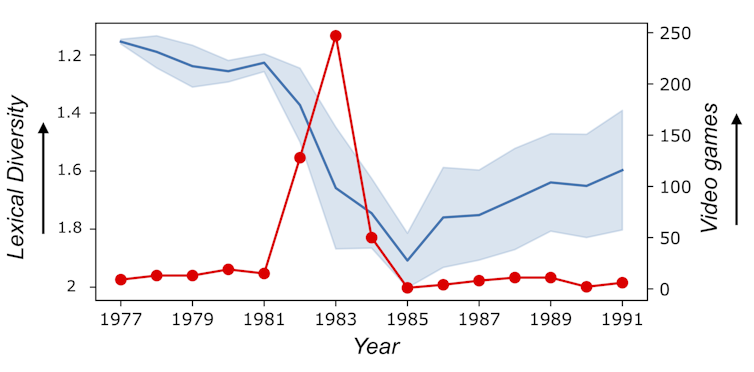
The boom-and-bust cycle in the number of Atari 2600 video games released between 1977 and 1991 (red line) matches a rapid and sustained loss of complexity in the internal computer codes (blue line). Salva Duran-Nebreda & Sergi Valverde
Indeed, we found that the collapse in number of products released was preceded by a measured decline in originality in each of our case studies. Between 1980 and 1983 the number of video games Atari released grew exponentially. This phase of enormous productivity corresponds to a marked and continuous loss of originality in its computer codes.
That is, with each copy, the underlying machine code for these games grew simpler and more repetitive. Imitation and the replication of the original games’ content contributed greatly in the run-up to the market collapse.
Innovation as a collective process
When modifications are made by copycats, rather than the experts who created the initial product, the original ideas of those experts can disappear under layers of incremental modifications. This “dilution of expertise” describes content that is copied and recopied with little inventive modification. The dilution is like making new pitchers of lemonade by adding water to each cup of lemonade taken from the previous batch.
As the copies multiply and the number of products grows, the expertise that gave freshness to the pioneering products is further and further buried, similar to the Atari cartridges in the landfill.

Monkey see, monkey do. Copying and imitation are fundamental to cultural evolution. Andre Mouton for Unsplash.com, CC BY
It is our belief that when expertise is diluted, original thinking is also diminished. For Atari, there were eventually too many Space Invaders-like games. With cryptocurrency, there have been many newly created cryptocurrencies similar to Bitcoin, but it remains the most popular. For Reddit, too many posts on a stale topic led users to lose interest, driving down the number of subscribers.
When imitations flood the market, the expert creativity that acted as a catalyst is diluted. Consumers lose interest, as with Atari, or investors lose their money when they can no longer distinguish innovation from a bad imitation.
Can we see it coming?
Imitation is not bad. After all, copying successful ideas is key to human culture and technology. New products are rarely created in isolation; past ideas are the building blocks for future innovation.
A booming trend in some creative products will likely bust when the number of copycats vastly outnumbers the supply of fresh ideas or “expertise.” The methodology used for our study may have the potential to predict such a collapse. In the future, this analysis could be applied to complex systems like technology patents or music genres. Expanding this framework could provide insights on the effect of collective imitation.







