


 Oil Prices Jump 3% as Houthi Attack Revives Supply Fears
  Fed Unveils Stablecoin Rules Under GENIUS Act
  Soybean Futures Slip as Traders Await Trump-Xi Trade Signals
  Asian Stocks Fall as Bond Yields Surge Ahead of Trump-Xi Summit
  China’s ‘Lipstick King’ Says AI Won’t Replace Livestream Hosts
  Wall Street Falls as Treasury Yields Surge, Oil Rebounds on Iran Tensions
  Oil Prices Ease as Iran Tensions Clash With Diplomacy Hopes
  Australia Unemployment Hits Five-Year High Despite Strong Jobs Growth
  US, China Extend Trade Truce to Jan. 10 Ahead of Trump-Xi Summit


 Add as a preferred source on Google
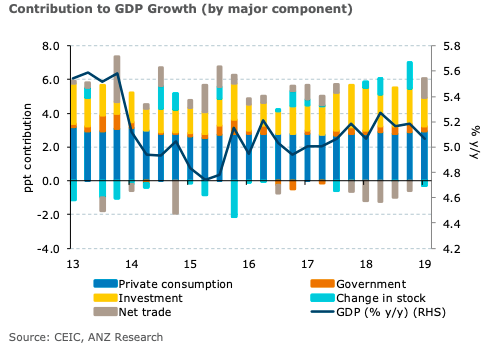
Indonesia’s growth in gross domestic product (GDP) eased during the first quarter of this year, broadly in line with expectations. While government spending growth picked up ahead of the April elections, and private consumption growth edged up, these were offset by a pullback in investment growth and a slump in exports.
The country’s growth slowed from 5.18 percent y/y in Q4 to 5.07 percent y/y in Q1, the softest reading in a year. The breakdown showed a slump in exports (-2.08 percent y/y), though a sharper fall in imports (7.75 percent) meant that net exports were a positive contributor to headline growth.
Government spending growth picked up from 4.56 percent y/y in Q4 to 5.21 percent y/y to Q1 ahead of the April elections, while private consumption growth (including non-profit institutions serving households) edged up slightly.
However, there was a significant pullback in investment growth from 6.01 percent to 5.03 percent, the slowest pace in two years. Meanwhile, inventories were a drag on growth in Q1 after providing a considerable boost the quarter before.
Looking ahead, domestic demand will be a key support to economic activity, but slowing global growth and weak prices for Indonesia’s key commodity exports such as coal and palm oil are impediments to faster growth. Lower export revenues would constrain firms’ profitability, the government’s revenues, and (potentially) workers’ incomes. Accordingly, Indonesia’s GDP growth is likely to remain stuck around the 5 percent-mark, ANZ Research noted its latest report.
"Today’s weak data strengthens the case for BI to lower its policy rate, and our base case is for two 25bps worth of cuts this year. BI has signalled a rising emphasis on supporting growth, as reflected by its announcement of a range of accommodative policies at its last monetary policy meeting in April. That said, the recent volatility in the rupiah suggests an imminent move at BI’s upcoming meeting on May 16 is unlikely," the report further commented.







