


 Global Central Banks Brace for More Rate Hikes as Inflation Risks Rise
  UBS Projects Mixed Market Outlook for 2025 Amid Trump Policy Uncertainty
  Wall Street Analysts Weigh in on Latest NFP Data
  RBA Says ASX Still Falls Short on Governance and Risk Controls
  China's Refining Industry Faces Major Shakeup Amid Challenges
  Gold Prices Fall Amid Rate Jitters; Copper Steady as China Stimulus Eyed
  Fed’s Hammack Says Bond Yield Surge Is Not Driven by Inflation Fears
  Trump’s "Shock and Awe" Agenda: Executive Orders from Day One
  Yen in Focus as BOJ, Fed Rate Hikes Reshape Currency Markets
  S&P 500 Relies on Tech for Growth in Q4 2024, Says Barclays
  Fed’s Williams Signals One More Rate Hike Before Year-End
  China’s Growth Faces Structural Challenges Amid Doubts Over Data
  UBS Predicts Potential Fed Rate Cut Amid Strong US Economic Data
  U.S. Stocks vs. Bonds: Are Diverging Valuations Signaling a Shift?


 Add as a preferred source on Google
The developments at the global level, especially the Fed and ECB interest rate cuts that the market is increasingly expecting for as early as July, and stable prospects for domestic inflation data speak in favor of a SARB rate cut. Although the inflation rate has recently risen slightly to 4.5%, it remains comfortably in the middle of the SARB target corridor, just like the core rate of 4.1%. Only the inflation expectations are not yet where the SARB would like to anchor them, which is close to the middle of its target corridor at 4.5%.
All in all, we expect that the majority of the board, which continues to consist of five instead of six members, will probably vote for a rate cut, all the more so as there has recently been a change here. Chris Loewald has been a newcomer to the board since the beginning of June. Daniel Mminele, the Vice-Governor is known as a hawk, retired from the board at the end of his term in June.
The forward rate agreements for 3-month money show that an interest rate cut has already been priced into a large part, which means that if anything, ZAR is likely to weaken only slightly. In our view, a larger reaction in the rand exchange rates might only emerge if SARB is to significantly lower its interest rate outlook which we do not expect though. We expect the SARB to adjust its interest rate outlook slightly downwards at best with reference to inflation risks-high wage pressure, rising food prices, rising oil prices and possible depreciation of the rand - and to initially adopt a wait-and-see stance.
In our view, a small interest rate cut and a rather wait-and-see attitude would also be a good way of appeasing the critics of the SARB within the ruling ANC, but without jeopardizing the credibility of the stability-oriented SARB. Slightly lower interest rates will accommodate the economy, which is on the brink of recession.
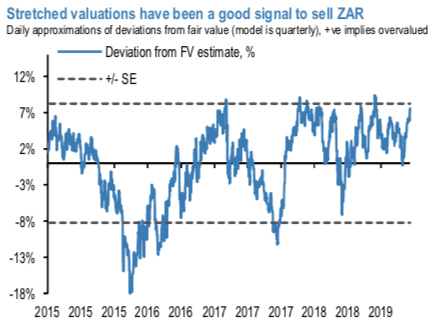
Furthermore, the valuations keep us bearish ZAR too. A truce in the US/China trade talks following the G20 meeting and a global pro-risk environment resulted in a sharp move lower in USDZAR. This was also supported by a bounce in South Africa’s export commodity prices.
However, despite the improvement in terms of trade, ZAR screens 7.6% rich in our BEER model suggesting that the recent move lower in USDZAR due to global factors seems stretched (refer above chart). As a result, we are comfortable holding our bearish view as domestic fiscal and growth challenges remain.
Contemplating the above factors, we activate a bullish USDZAR put spread for a potential China/global growth stabilization (1m/1w, 13.80/14.1230). Using mild rallies, decide to initiate a bull put spread for net credits, so short 1W (-1%) in the money put with positive theta if you expect that USDZAR will spike up moderately over the next near future but certainly not beyond your imagination, simultaneously, go long in out of the money -0.40 delta put option of 1m expiries with a view to arresting further downside risks. Courtesy: JPM & Commerzbank







