


 South Africa Eyes ECB Repo Lines as Inflation Eases and Rate Cuts Loom
  Dow Hits 50,000 as U.S. Stocks Stage Strong Rebound Amid AI Volatility
  Russian Stocks End Mixed as MOEX Index Closes Flat Amid Commodity Strength
  Elon Musk’s Empire: SpaceX, Tesla, and xAI Merger Talks Spark Investor Debate
  Vietnam’s Trade Surplus With US Jumps as Exports Surge and China Imports Hit Record
  UK Starting Salaries See Strongest Growth in 18 Months as Hiring Sentiment Improves
  Trump Lifts 25% Tariff on Indian Goods in Strategic U.S.–India Trade and Energy Deal
  BTC Flat at $89,300 Despite $1.02B ETF Exodus — Buy the Dip Toward $107K?
  Japanese Pharmaceutical Stocks Slide as TrumpRx.gov Launch Sparks Market Concerns


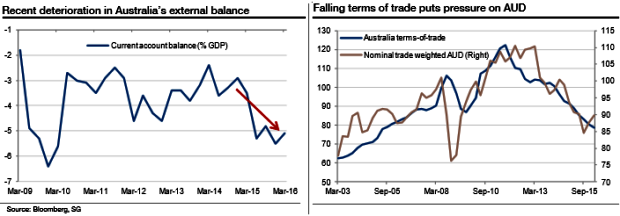
In H2, we expect AU growth to remain subpar and AUD to drift lower. There are a few key things to watch in 2016. Governor Stevens retires in Sept 2016 while a federal election must be held tomorrow; opinion polls are fairly evenly balanced, although betting markets suggest a Liberal-National Coalition win.
The shock Brexit result is likely to be an important part of the policy deliberations when the RBA Board meets on next Thursday, while AU’s current account deficit is also worth tracking.
The fundamental backdrop for the Australian dollar remains challenging, though the trade-weighted AUD has fallen significantly from its highs in early 2012. The Australian economy is gradually transitioning away from the natural resource sector, aided by low-interest rates and a weaker currency.
But the current account imbalance has widened in recent quarters, non-mining CapEx growth has been elusive, the RBA is firmly on a dovish policy setting, the above chart shows that FX market implied volatility is elevated, Fed policy normalisation remains on track and risks to the Chinese growth outlook abound.
The Australian terms of trade are still falling, and thus the fundamental path of least resistance for AUD is for further depreciation. This, plus the persistent and surprising disinflationary pressures in Australia, has kept the RBA on an easing bias, with one rate cut expected in H2 16. Monetary divergence should thus be another factor in the second half of the year for a lower AUD/USD as the Fed readies to tighten again.
The persistent weakness in nominal GDP growth has had negative consequences for government revenues, and fiscal policy should remain constrained. The opposition Labour Party has committed itself to fiscal consolidation to preserve Australia’s AAA credit rating. There is thus unlikely to be significant changes to fiscal policy whatever the outcome of the July 2016 general elections.
Moreover, global macro uncertainty has buoyed global FX implied volatility. This has historically been a negative factor for AUD and we expect it to remain so. While we do see further weakness in AUD through H2 16, it should be at a more gradual pace given the sizeable valuation mean-reversion that has already occurred. But we do see value emerging in the AUD/NZD cross at current levels.













