


 BOJ Minutes Signal More Rate Hikes as Inflation Risks Grow
  Singapore Central Bank’s Exchange Rate Policy Explained: Why MAS Uses the S$NEER Instead of Interest Rates
  Fed Holds Interest Rates Steady as Kevin Warsh Says Rising Treasury Yields Tighten Financial Conditions
  BSP Sees Philippine Inflation Easing, Keeps Policy Options Open
  Japan Services Producer Prices Rise 3.2% in June, Supporting BOJ Rate Hike Expectations
  Chile Central Bank Holds Interest Rate at 4.5% as Inflation and Global Risks Persist
  Australia Inflation Cools as Core CPI Misses Forecasts, Easing RBA Rate Hike Pressure
  Japan Government Backs Earlier BOJ Rate Hike as Inflation Pressures Build
  Brazil Cuts Selic Rate to 14% as Inflation Eases but Risks Persist


 Add as a preferred source on Google
A day ahead at a glance EURUSD broke above 1.16 last week, it may be 1.18 come to the next ECB meeting in September. US interest rates rose slightly while the USD consolidated near a one-year low. There was little news to drive markets.
Wednesday’s FOMC meeting is the highlight of the calendar this week and while our baseline is for no change, recent rhetoric suggests a chance that an announcement on balance sheet reduction could come this week.
Given the current mood, however, there is no guarantee that such a decision would support the greenback; markets may simply perceive this as the dovish alternative to an actual rate hike.
The main focus of attention for the day has been IFO survey, that has produced upbeat numbers (actual 116 versus f/c 114.9 and previous 115.2) providing a further update on the German economy.
This follows yesterday's ‘flash’ PMI data for July, with German manufacturing and services PMI’s slipping to their lowest level since April and February respectively.
Amid a mild bearish sentiment of EURUSD today, it remained above 1.1650 during European trading sessions, likely to edge towards 2-years highs of 1.1714 levels. This has already been very well anticipated as the next semester should see the euro break above its range of the last few years, and interest rate volatility fueled by central banks exiting accommodation will be channeled towards FX.
Data schedules:
July 26: Australia 2Q CPI, UK 2Q GDP, US new home sales, and FOMC meeting.
July 27: US durable goods orders.
July 28: Japan CPI, France 2Q GDP, France CPI, Sweden 2Q GDP, Germany CPI, Canada May GDP, and US 2Q GDP.
OTC updates:
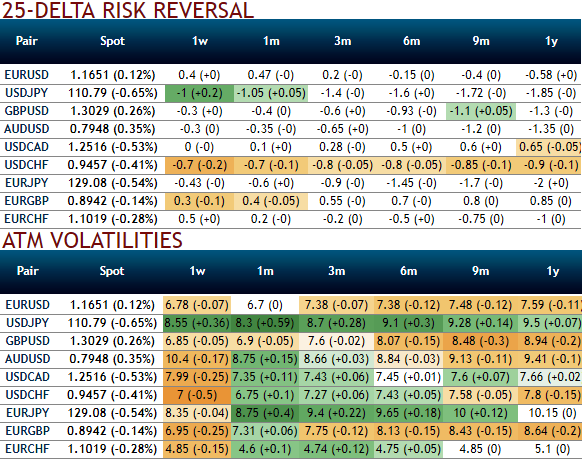
Please be noted that despite above-mentioned data events, EURUSD IVs are shrinking away with neutral shifts in risk reversals, while 1-3m RR has currently turned into positive flashes to mitigate bullish risk sentiments, while the 3m and 1y are lower than one vol for EUR puts. Crossing the line whereby euro calls become more expensive than puts may not be that far away. While the positively skewed IVs of 1m tenors signify upside risks of the underlying pair.
EURUSD risk reversals, in the recent past, have flipped onto calls from puts. A positive RR means that the euro tend to appreciate faster than it falls, reflecting the durable positive correlation between the dollar’s level and its volatility.







