


 Gold Prices Fall Amid Rate Jitters; Copper Steady as China Stimulus Eyed
  Fed Minutes Signal Another Rate Hike by Year-End
  Oil Prices Trim Gains After Trump Rules Out Iran Strikes Before Midterms
  Deere, CNH and AGCO Stocks Fall as FTC Launches Farm Equipment Probe
  BOJ Signals Faster Rate Hikes as Inflation Risks Grow
  RBI Rate Hike Bets Surge as Inflation Rises
  Gold Prices Rise as Hormuz Tensions Fuel Inflation Risks
  Crypto Market Selloff Wipes Out $100B as Bitcoin Falls Below $83K


 Add as a preferred source on Google
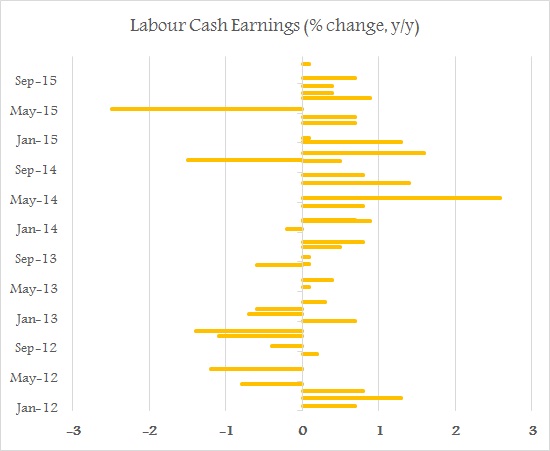
Bank of Japan (BOJ) ambitious easing has so far failed to achieve targeted inflation path as consumers have scaled back their purchase after sales tax hike of 2% and now latest earnings data released today, show that ambition may remain out of reach as wages are hardly growing.
Labour cash earnings reported wages only edged up by 0.1% in December, compared to level a year ago. So economists are posing a serious question - if economy is growing just about 1.6% y/y and inflation is hovering at near zero level, why should companies pay higher wages, more so for firms, focused into domestic market, who are not major beneficiaries of weaker Yen. Bank of Japan's (BOJ) selective buying into equities, are not large enough to compensate corporations to increase wages.
Figure shows, increase in Labour earnings were quite visible and had strong momentum back in 2013/14 but has become more subdued as global growth weakens.
As early as last month, BOJ had introduced negative rates on excess reserve but the current three tier system adopted by BOJ leaves enough wiggle room for banks and total deposit unlikely to earn a net negative until the very late.
Moreover, with negative rate introduction, it is more likely that BOJ would adjust in that front, rather than to boost purchase.
Yen is currently trading at 117.2 per Dollar, much stronger than 125 level seen last year.







