


 Asian Currencies Steady as Dollar Weakens After Treasury Bond Buybacks
  South Korea Producer Prices Fall 0.4% in July
  Gold Prices Fall Amid Rate Jitters; Copper Steady as China Stimulus Eyed
  Best Gold Stocks to Buy Now: AABB, GOLD, GDX
  Japan Services Producer Prices Rise 3.2% in June, Supporting BOJ Rate Hike Expectations
  Switzerland Industrial Production Jumps 5.5% in Q2 2026


 Add as a preferred source on Google
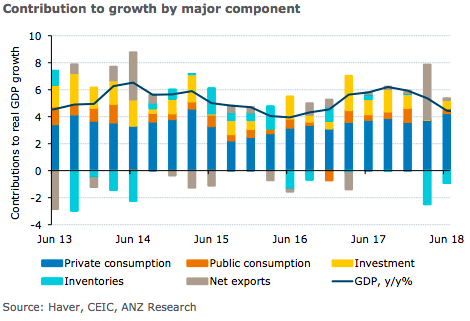
Bank Negara Malaysia (BNM) is expected to remain accommodative and growth supportive, with the Overnight Policy Rate (OPR) likely to be maintained at 3.25 percent throughout this year, according to the latest report from ANZ Research.
Malaysia’s gross domestic product (GDP) registered 4.5 percent y/y growth in Q2, down from 5.4 percent y/y in Q1. Private consumption, which has been the mainstay of growth, found further support from the withdrawal of GST on June 1.
Weak exports, coupled with buoyant imports, resulted in net exports subtracting 1.6ppts from growth in the quarter. The strains from global trade tensions have become apparent in the loss of momentum in exports in recent months.
Private consumption, which expanded 8 percent y/y compared with 6.9 y/y previously, has been the mainstay of growth and received a fillip with the withdrawal of the GST on June 1. Higher investment in “machinery & equipment” helped buoy overall investment activity at 2.2 percent y/y in Q2 (Q1: 0.1 percent). However, tepid construction activity resulted in investment in structures growing a meagre 2.1 percent y/y.
In the run up to the May elections, firms seem to have held back. Post-elections, as the new government placed key infrastructure projects under review, investments linked to such projects seem to have been delayed further. After the large draw-down in inventories in Q1, restocking demand is yet to pick up.







