


 Vietnam’s Trade Surplus With US Jumps as Exports Surge and China Imports Hit Record
  RBI Holds Repo Rate at 5.25% as India’s Growth Outlook Strengthens After U.S. Trade Deal
  Asian Markets Surge as Japan Election, Fed Rate Cut Bets, and Tech Rally Lift Global Sentiment
  Trump’s Inflation Claims Clash With Voters’ Cost-of-Living Reality
  UK Starting Salaries See Strongest Growth in 18 Months as Hiring Sentiment Improves
  Trump Signs Executive Order Threatening 25% Tariffs on Countries Trading With Iran
  Gold and Silver Prices Climb in Asian Trade as Markets Eye Key U.S. Economic Data
  Bank of Japan Signals Readiness for Near-Term Rate Hike as Inflation Nears Target
  Trump Lifts 25% Tariff on Indian Goods in Strategic U.S.–India Trade and Energy Deal
  China Extends Gold Buying Streak as Reserves Surge Despite Volatile Prices
  U.S.-India Trade Framework Signals Major Shift in Tariffs, Energy, and Supply Chains
  Nikkei 225 Hits Record High Above 56,000 After Japan Election Boosts Market Confidence
  Asian Stocks Slip as Tech Rout Deepens, Japan Steadies Ahead of Election
  Japan Economy Poised for Q4 2025 Growth as Investment and Consumption Hold Firm
  South Africa Eyes ECB Repo Lines as Inflation Eases and Rate Cuts Loom
  Oil Prices Slip as U.S.-Iran Talks Ease Middle East Tensions


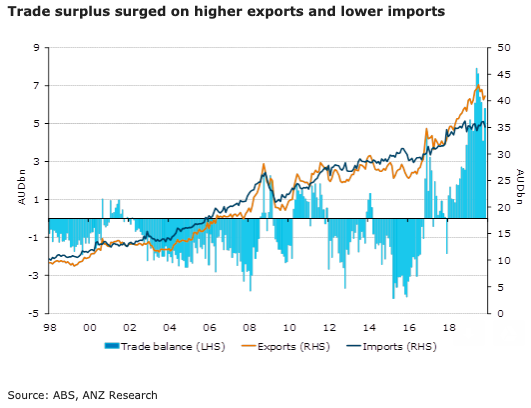
Australia’s trade surplus surged to AUD5.8bn in November, well above our and market expectations. The rise in the trade surplus was from a combination of higher exports and lower imports, up 1.8 percent m/m and down 2.8 percent m/m respectively. Stronger resources and services exports drove most of the increase.
By our reckoning, the stronger resource export figure reflects an increase in volume. Imports on the other hand were down, with a particularly sharp decline in consumption goods. This decline is further indication that household spending is subdued.
Total resource exports rose 0.9 percent m/m in November and are now 3 percent higher than a year ago. The increase largely reflects higher iron ore exports, which rose 2.1 percent m/m, as well as LNG, up 0.9 percent m/m. These rises were partially offset by a sharp decline in non-monetary gold, which fell 6 percent m/m, continuing the strong decline in the previous month.
The RBA’s commodity price index was down 3.8 percent in November, which suggests that the rise in resource exports was likely due to a rise in volume. Manufacturing exports had a soft month, down 0.3 percent m/m, which follows the large rise in the previous month. Service exports continued to rise, up 1.1 percent m/m, leaving them 8.9 percent higher than a year ago.
Consumption imports fell 6.6 percent m/m, leading the fall in imports. A large part of this was driven by a 20.7 percent m/m decline in car imports, which are now down over 19 percent y/y. The capital goods imports figure was the other large fall for the month, declining 3.9 percent m/m. Fuel imports were down 4.9 percent m/m, largely reversing the sharp rise the previous month.
"Looking forward to last December’s trade balance figures and the next two quarters, we will be looking for any impact from the bushfires on tourism-related expenditure," ANZ Research commented in its latest report.













