


 U.S. 10-Year Treasury Yield Hits 2007 High as Fed Rate Hike Bets Rise
  Australia Unemployment Hits Five-Year High Despite Strong Jobs Growth
  Oil Prices Extend Losses as U.S.-Iran Talks Ease Supply Fears
  Russian Envoy Dmitriev Heads to US for Ukraine Talks
  Mexico-US Trade Talks Delayed to October as Tariff Negotiations Continue
  FxWirePro: Daily Commodity Tracker - 21st March, 2022
  US Stock Futures Rise as Meta Muse Fuels AI Rally
  US Dollar Hits Two-Month High as Fed Rate Hike Bets Rise
  Gold Prices Rise as Oil Slump Eases Fed Rate Hike Fears
  China’s ‘Lipstick King’ Says AI Won’t Replace Livestream Hosts


 Add as a preferred source on Google
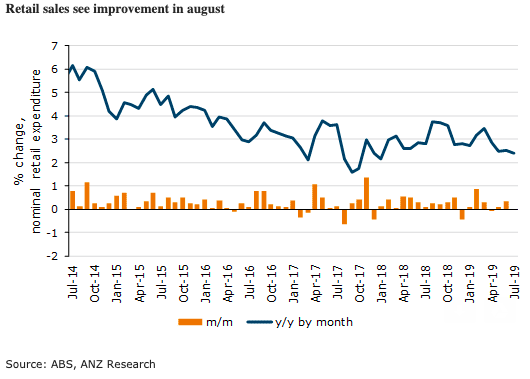
Australia’s retail sales grew by 0.4 percent in August, below ANZ and market expectations. This upgrade compared with recent months (0.2 percent m/m average for the last 6 months) represents the early effects of tax and rate cuts, ANZ Research reported.
Uncertainty about the labour market and other economic conditions may have caused some shyness among recipients of extra income - including early tax cut recipients and mortgagees (who can reduce payments as rates fall).
Annual growth increased to 2.6 percent. This is a little higher than the past few months, but still below the 1-yr, 3-yr and 5-yr averages.
Clothing was a standout, with 4.9 percent y/y growth after a strong monthly result (1.8 percent m/m). Department stores (1.1 percent m/m) and recreational goods (2.9 percent m/m) also saw strong monthly growth, hinting that tax cuts were stimulating short-term discretionary spending.
In y/y terms, key non-discretionary categories including supermarket and grocery stores (4.2 percent y/y) and pharmaceutical, cosmetics and toiletries (4.8 percent y/y) continued to see stronger growth than discretionary categories. This speaks to the longer term budget pressures on households, who are focusing more on “essentials” and less on “nice to haves”.
Monthly growth was strongest in QLD (0.8 percent m/m) and ACT (1.9 percent m/m) while annual results show strength in QLD and VIC, and weakness in NSW.







