


 BlackRock’s Rick Rieder Favors Bonds Over Stocks as Treasury Yields Surge
  Gold Slides Below $4,300 as Oil Surge Fuels Fed Rate Hike Bets
  Asian Chip Stocks Tumble as OpenAI Safety Pause Sparks AI Growth Concerns
  Oil Prices Rise as Iran Holds Firm on Strait of Hormuz Deal
  China Cuts Tariffs on U.S. Farm Goods but Excludes Soybeans
  South Korea Exports Set for 16th Monthly Gain on AI Chip Demand
  South Korea Tax Windfall Could Top 50 Trillion Won on Chip Boom
  Nvidia China Chip Sales Report Sends Chinese Semiconductor Stocks Lower


 Add as a preferred source on Google
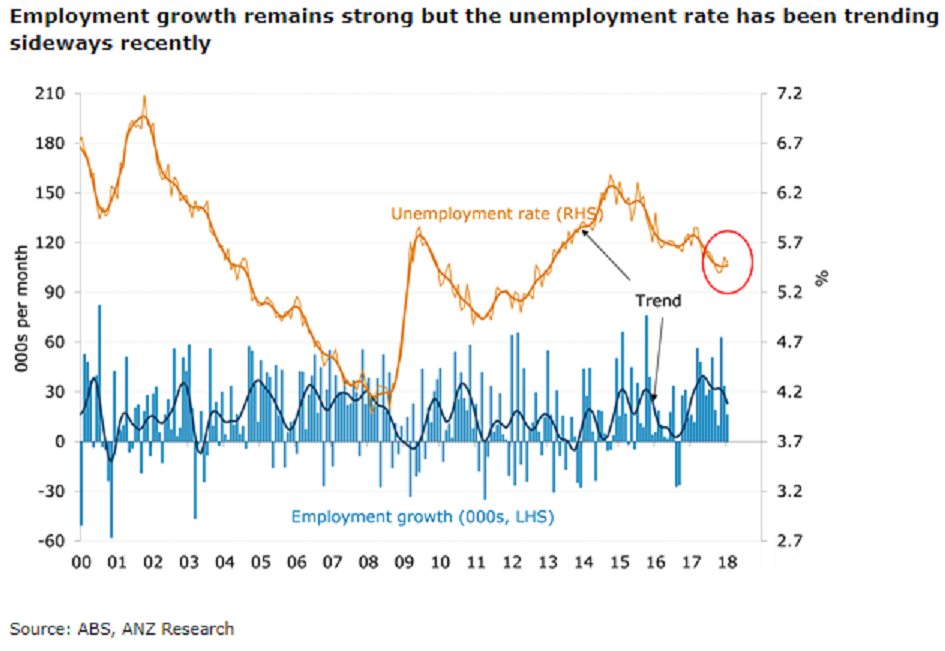
Australian employment rose to a record 16 consecutive monthly gains. The drop in full-time jobs and the recent stabilization of the unemployment rate took some of the gloss off the report, however. Recent stability in the unemployment rate is consistent with the Reserve Bank of Australia’s (RBA) willingness to be patient on policy normalization. That said, leading indicators suggest that employment is likely to grow solidly and the unemployment rate decline over coming months.
After a very strong run, employment rose a more moderate 16k in January, after a 33k rise in December. This is the 16th straight monthly rise in employment, beating previous records including 1994 when Australia was dragging itself out of a deep recession after unemployment surpassed 11 percent.
Putting a dampener on the report was a sharp fall in full-time jobs (-50k). Part-time employment rose 66k. This mix was reflected in hours worked, which fell a sharp 1.4 percent m/m. The national unemployment rate ticked down to 5.5 percent, although this came alongside an upward revision to December unemployment to 5.6 percent, from previous 5.5 percent.
The participation rate nudged slightly lower from 65.7 percent to 65.6 percent. The female participation rate maintained its record high of 60.5 percent, while male participation ticked down to 70.9 percent from 71 percent.
"While we have been expecting a moderation in the employment numbers for a few months now, leading indicators continue to suggest that the labor market remains in good shape. Business conditions and profitability remain very buoyant, and job ads continue to trend higher. On this basis, we expect further gains in employment and a further decline in the unemployment rate in coming months," ANZ Research commented in its latest research report.
Lastly, FxWirePro has launched Absolute Return Managed Program. For more details, visit http://www.fxwirepro.com/invest







