


 Oil Prices Surge as U.S.-Iran Diplomacy Hopes Fade
  Asian Stocks Fall as Surging Bond Yields Rattle Markets
  Asian Currencies Mixed as Dollar Holds Near Two-Month High
  US, China Extend Trade Truce to Jan. 10 Ahead of Trump-Xi Summit
  Oil Prices Jump 3% as Houthi Attack Revives Supply Fears
  Gold Holds Near $4,275 as Rising Treasury Yields Fuel Fed Rate Hike Bets
  Wall Street Falls as Treasury Yields Surge, Oil Rebounds on Iran Tensions
  RBI Uses $10 Billion Currency Swaps to Drain Excess Rupee Liquidity
  Soybean Futures Slip as Traders Await Trump-Xi Trade Signals
  Gold Prices Fall Amid Rate Jitters; Copper Steady as China Stimulus Eyed


 Add as a preferred source on Google
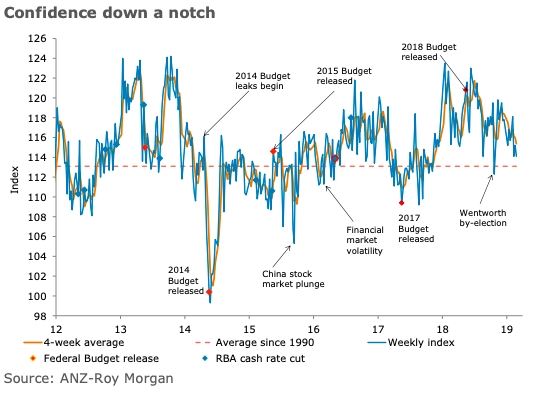
Australia’s ANZ-Roy Morgan consumer confidence retraced last week’s gain, declining 1.0 percent but remaining above the long-run average by some margin.
Financial conditions sub-indices were down with current financial conditions declining 0.9 percent and future financial conditions taking a bigger hit of 5.3 percent. This only took future financial conditions down to around the long-run average, however.
Economic conditions were mixed, with current economic conditions falling 1.6 percent while future economic conditions gained 0.5 percent. The ‘time to buy a household item’ moved higher for the second week, gaining 2.9 percent. Four-week moving average inflation expectations were stable at 4 percent.
"Confidence took a U-turn by falling 1.0 percent last week. The fall was somewhat surprising considering strong employment growth and reasonable wage data. The turn to a more negative outlook by one of the major Australian banks and news stories about a ban on Australian coal imports by Chinese port authorities that were then denied by authorities may have offset the positive economic data. Consumer confidence has effectively been in a holding pattern over the past three weeks, though the important thing to note is that it has remained above the long-run average," said David Plank, ANZ’s Head of Australian Economics.







