


 Soybean Futures Slip as Traders Await Trump-Xi Trade Signals
  European Stocks Fall as Bond Yields and Geopolitical Risks Weigh
  Dollar Holds Near Two-Month High as Yen Approaches 160
  US, China Extend Trade Truce to Jan. 10 Ahead of Trump-Xi Summit
  Best Gold Stocks to Buy Now: AABB, GOLD, GDX
  Asian Currencies Mixed as Dollar Holds Near Two-Month High
  South Korea, US Discuss Warship Building Cooperation


 Add as a preferred source on Google
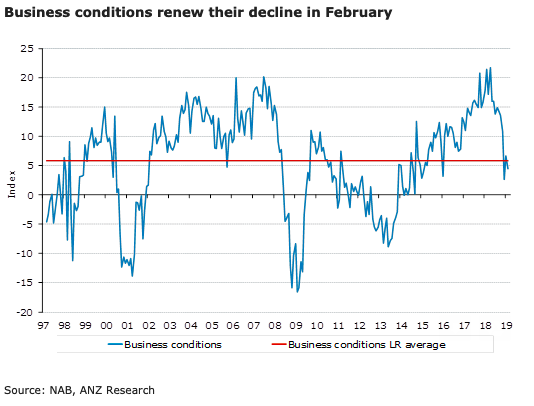
Australia’s business conditions fell to 4.4 in February, reversing much of the bounce in January from the sharply weaker December numbers. Indeed, some of the key numbers are weaker than in December – notably forward orders and exports.
Capacity utilisation fell again, to its lowest level since October 2016. This points to a rising unemployment rate in the months ahead. The weakness in business conditions adds to other evidence of a continued loss of momentum in the economy after the weak Q4, such as the latest ANZ Roy-Morgan Australian Consumer Confidence data, according to the latest report from ANZ Research.
The details of the report were mostly consistent with the headline. One category to counter the downtrend was the employment index, which rose to 5.4 from 5 in January and 3.9 in December. It is still well below the levels prevailing through most of last year, however.
Conditions were mixed across the states. Conditions in NSW fell to the lowest level since 2014, while those in Vic and WA rose a touch. Conditions in SA continued to be volatile, dropping sharply after the big bounce in January. Tas is now the only state where conditions are above the long-run average.
Across industries, construction was down sharply and retail deteriorated further. Meanwhile, the transport and finance categories bucked the overall trend and posted gains.







