


 Indonesia Plans Higher Asset Yields to Boost Rupiah and Restore Investor Confidence
  China Keeps Loan Prime Rates Unchanged for 13th Straight Month as Policymakers Prioritize Credit Demand Recovery
  Fed Chair Kevin Warsh Signals Policy Overhaul as Hawkish Rate Outlook Rattles Markets
  BOJ Rate Hike Expectations Rise as Weak Yen and Strong U.S. Jobs Data Increase Pressure
  New Zealand Unemployment and Inflation Debate Intensifies Ahead of 2026 Election
  Taiwan Central Bank Likely to Keep Interest Rates Unchanged Through 2027
  Japan Signals Preference for Low Interest Rates as BOJ Policy Debate Intensifies
  RBA Expected to Hold Interest Rates at 4.35% as Markets Watch AUD/USD and ASX 200


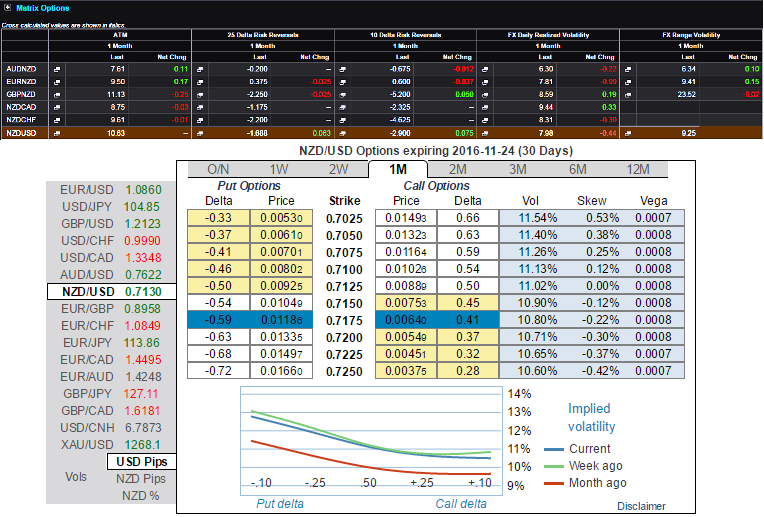
Ahead of RBNZ’s monetary policy meeting that is scheduled next week, the market pricing for a November OCR cut has been stable during the past two weeks at around 80% (currently 86%).
Q3 CPI data was unsurprising to RBNZ forecasts, although it did surprise a number of analysts who expected something lower.
The markets have consistently priced in a greater than 50% chance of a November cut since Assistant Governor McDermott’s speech in September reminding all that the “promised” cut remains in the pipeline.
So what could spook them from cutting? A sharp rise in inflation expectations on 2 Nov (unlikely, given CPI is running at only 0.2%/yr), or a plunge in the NZD, come to mind. We continue to expect a cut on 10 Nov, followed by a lengthy pause.
Consequently, the participants in NZD OTC market are getting active, 1m IVs are screaming off over 11.02% and positive skew is observed in OTM put strikes.
Implied volatility is elevated compared to realized volatility (see above nutshell), suggesting a structure selling it.
The downside skew is not sufficiently elevated to finance a put via low strikes (a put spread-like structure), but the negative skew is enough to obtain an attractive discount via a downside knock-out. Such a barrier is appropriate for trading moderate NZD/USD downside.







