


 Oil Prices Surge Over $5 as Trump Vows to Continue Iran Strikes
  Oil Prices Slide as Iran Tensions Ease and U.S. Crude Stockpiles Swell
  RBC Capital: European Medtech Firms Show Minimal Middle East and Energy Risk Exposure
  U.S. Stocks Surge on Iran War De-escalation Hopes
  U.S. Dollar Posts Strong Monthly Gain Amid Middle East Conflict Despite Late Dip
  U.S. Stock Futures Steady Amid Iran Ceasefire Talks and Trump Address
  Asian Stocks Drop as Trump Signals Iran War Escalation
  Gold Prices Rebound in Asia Amid Iran War Ceasefire Hopes
  Oil Prices Climb as Middle East Conflict Keeps Supply Risks Elevated
  Trump's Claim That the U.S. Can Cover Global Jet Fuel Shortfall Doesn't Add Up
  Gold Prices Rebound But Head for Worst Month Since 2008 Amid Iran War Uncertainty
  South Korea's Exports Hit Record High in March on AI-Driven Chip Demand
  Oil Prices Hold Near Multi-Year Highs Amid Iran Conflict and Hormuz Supply Fears
  Asian Stocks Surge on Trump's Iran War Comments and Dip-Buying
  South Korea's Inflation Rises Modestly in March Amid Oil Price Pressures
  Canada's Economy Grows Modestly in January 2025, Driven by Energy and Construction


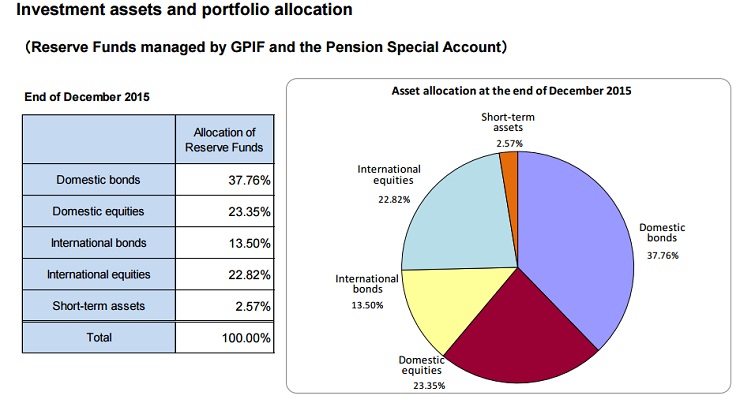
World’s biggest Pension fund, Japan’s GPIF could be in troubled water this year and that is due to its venture to riskier assets back in 2014, when Bank of Japan (BOJ), increased its monetary stimulus by another ¥10 trillion per annum. This year BOJ introduced further stimulatory measures such as introduction of negative rates, for first time in its history, but the reactions haven’t been as intended so far.
Nikkei’s underperformance:
- While S&P 500 recovered from its January, February losses and now positive for the year, Japan’s benchmark stock index, Nikkei 225 is still down about 9.5% for the year. Even some emerging markets like India is much better performer, which is down just -2.3% YTD.
GPIF asset shift –
- Back in December, 2013, approximately 62.5% of the assets were consisted of bonds, while little more than 15% were invested in international stocks and 17.2% in domestic stocks.
- By third quarter of 2015, GPIF’s holding of bonds were reduced by approx. 14%, while that part went into equities. Now about 46.1% of the total $1.2 trillion portfolio is invested in equities, of which 245 invested in home.
Troubles since last year:
- Since last quarter peak around 21000, Nikkei is down about 19%, while bonds have rallies sharply. Moreover if GPIF increased greater portion of its portfolio to European equities for its international position, then it must be sitting on another set of large loss. European blue chip index, EuroStxx50 is down more than -6% for the year and about -17% in last 12 months. Stronger Yen since last quarter likely to deteriorate this numbers.
While large portion of this is still will be paper loss, losses in whatever forms in a pension fund is likely to be very big issue for a country, with largest share of elderly in its population.
These paper losses pose big risks for Prime Minister Shinzo Abe, which is facing election in upper house in summer and GPIF will be announcing the quarterly result before that.







