


 FxWirePro- Crypto Weekly Alpha: ETF Rebounds, L2 Rallies & Key Resistance Levels
  NASA, Boeing Discuss Expanding Starliner Missions
  Japan, U.S. Discuss $19 Billion GlobalFoundries Chip Plant
  White House Bars CNN, MS NOW and Politico Reporters
  Supertanker Orders Surge as US-Iran War Reshapes Oil Trade
  Hyundai CEO Warns Chinese Automakers Could Disrupt US Market
  Banking scandal rocks Brazil’s politics and the country’s presidential election in October
  Petrobras Joins Brazil’s New Diesel Subsidy Program
  FAA Allows Boeing to Sell 35 More 777F Freighters Beyond 2028
  Allegro Raises 2026 Outlook as International GMV Surges
  US Federal Register Drops Alibaba Qwen AI Search Tool


 Add as a preferred source on Google

Last summer, the northern hemisphere was the hottest it has been for 2,000 years.
The warnings of climate scientists are at fever pitch: halt the burning of coal, oil and gas or risk catastrophic warming of at least 2.5°C. With solar and wind energy plentiful and supposedly cheap to harvest, why is ditching fossil fuel so hard anyway?
Renewable sources generate nearly a third of the world’s electricity – and a handful of new studies suggest that rapidly decarbonising the remainder is possible.
In fact, some evidence suggests the transition needn’t be all that painful.
Shovels at the ready
“Over half of Africa’s people – about 600 million – lack access to even the bare minimum of electricity,” say Christiane Zarfl and Rebecca Peters, environmental systems analysts at the University of Tübingen.
“The tough question to answer is how access can be extended without adding to global warming by relying on fossil fuels.”
When Zarfl and Peters analysed publicly available data on hydro, solar and wind energy in Africa, they found that enough was in the pipeline in Nigeria and Zimbabwe to make fossil power obsolete in both countries by 2050.
Even more encouraging was their conclusion that 76% of Africa’s power needs in 2040 could be met by renewables if existing plants work at full capacity and all planned projects are built.
The pair acknowledge that hydropower, Africa’s leading renewable source to date, is not expected to turn a profit after 2030. Happily, wind and solar can make use of existing dams – with floating photovoltaic panels on reservoirs, for instance.
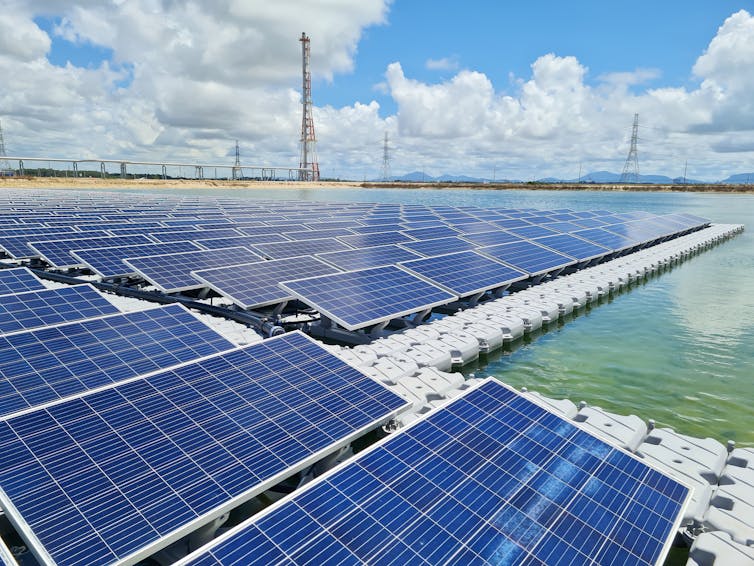
Hybrid projects could see solar and hydropower plants combine. Supawit.S/Shutterstock
Solar and wind power can generate electricity on almost any surface sufficiently exposed to the elements (your roof could be a good candidate).
Andrew Blakers, a professor of engineering at Australian National University, calculated how much space was needed to build the panels, turbines and power lines necessary for decarbonising Australia’s electricity and was startled by the result.
“All we need is 1,200 square kilometres,” he says.
“That’s not much. The area devoted to agriculture is about 3,500 times larger at 4.2 million square kilometres. The area of land that would be taken away from agriculture works out at about 45 square metres per person – about the size of a large living room.”
Renewable energy can be generated on land reserved for another purpose. Panels and turbines that are spaced out to maximise how much sun and wind each one catches offer room for crops to grow and livestock to graze, Blakers says.
The mix of shade and rainfall exposure created by solar panel arrays could even have ecological benefits according to Matthew Sturchio, a PhD candidate in plant and ecosystem ecology at Colorado State University.
“In some cases, mixed conditions like these, with varying levels of light and water, can be a good thing. A well-tested concept in restoration ecology – the science of restoring damaged ecosystems – is that environments with more variety support more diverse mixes of plants and animals.”
Not so fast…
If the technical barriers to zero-carbon power are falling then the economic ones appear more stubborn.
The growth of the US offshore wind industry, which began sending power to north-eastern states earlier this year, has stalled due to rising costs.
“Several big hitters, including Ørsted, Equinor, BP and Avangrid, have cancelled contracts or sought to renegotiate them in recent months,” says Christopher Niezrecki, director of the Center for Energy Innovation at UMass Lowell.
“Altogether, projects that had been cancelled by the end of 2023 were expected to total more than 12 gigawatts of power, representing more than half of the capacity in the project pipeline.”
You’ve probably read how cheap it is to generate electricity from the sun and wind. These estimates tend to be averaged over the entire lifetime of a project, which may be 20 years for the average wind turbine.
This obscures how expensive (and laborious) it is to get approval for and build a solar or wind farm in the first place.
“One of the largest contributors to the cost of generating renewable energy is the upfront cost of raising investment,” says Matteo Gasparini, a DPhil candidate in climate and finance at the University of Oxford.
“Banks tend to lumber riskier investments with higher interest rates, and so these rules could make it more expensive to finance the construction of wind and solar farms.”
Investors baulk at putting their money into anything that might later be buffeted by unforeseen costs. According to Gasparini’s research, European banks see renewables as a bigger liability on their balance sheets than fossil fuels.
“Our analysis showed that the average estimate of risk among EU banks for high-carbon sectors of the economy was 1.8%, compared with 3.4% for low-carbon sectors (calculated as Euros a bank expects to lose with each unit of lending).”
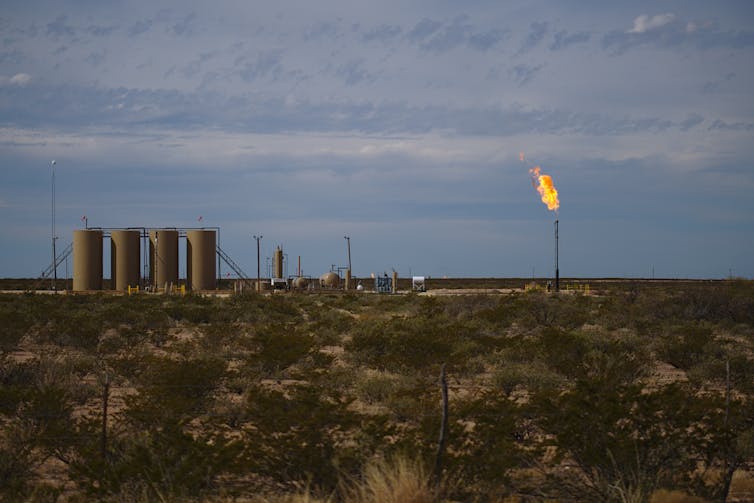
Oil and gas: still a better bet for banks. Sean Hannon acritelyphoto/Shutterstock
The transformation of our climate-damaging energy system doesn’t have to be at the whim of banks and investors. If the fate of humanity is at stake, shouldn’t people have more control over the process?
“Publicly owned systems for generating electricity could restore and expand the capacity for democratic control of a sector that provides a vital public benefit”, argue Vera Weghmann and David Hall, researchers in public services at the University of Greenwich.
“After all, the job of the public sector is to serve public interest, so taxpayers’ money doesn’t get diverted to benefit private shareholders.”







