


 AI is supercharging money scams – here’s what you can do to protect yourself
  Taiwan Vows to Advance US Arms Sales Ahead of Trump-Xi Meeting
  Big AI wants to slow down AI research. Is it a safety pause or a strategic retreat?
  Lula and Flavio Bolsonaro Tied in Brazil Runoff Poll
  US, Japan and South Korea Back Taiwan Ahead of Trump-Xi Summit
  Gold Slides to $4,262 as Hawkish Fed Rate Hike Triggers Technical Breakdown
  Synthetic data could ease people’s concerns about privacy breaches. But who gets to create it?
  Macron Challenges Trump’s Gaza Peace Claims at UN
  Trump Administration Prepares Sanctions Against Entire ICC
  What is Zionism? The different meanings of a contested term
  Scott Bessent Eyed as Trump’s New AI Czar
  Zelenskiy Warns Russia Preparing Major Attack on Ukraine


 Add as a preferred source on Google

Donald Trump’s tariffs will make many things more expensive for his fellow US citizens. The price of imported cars, building materials and some tech will go up – and so will the cost of the food on American dining tables.
The US currently imports around 16% of its food supply, with a large proportion of its fruit and vegetables coming from countries now hit by tariffs.
Mexico stands out. It supplies over half the fresh fruit and nearly 70% of the fresh vegetables consumed in the US.
And even when it comes to home grown produce, the US still depends on imported fertiliser for its crops, with Canada providing up to 85% of its neighbour’s supply.
So grocery bills for American families, especially for fresh produce (and processed foods dependent on foreign ingredients) will get higher. But there will also be a noticeable effect on food prices outside the US.
The consequences could be particularly serious for developing economies that rely on stable international prices to secure affordable food imports. The prices of many global staples including maize, wheat and soybeans are benchmarked against US markets so when disruptions occur, they reverberate globally.
Research I conducted with a colleague found that when international prices are disturbed, local food prices, especially in developing countries, go up.
Take global maize prices, which this year rose by 7% between April 2 (Trump’s “liberation day”) and April 11. Our study suggests this will immediately lead to a similar increase in local maize prices in places like sub-Saharan Africa.
This is where many of the world’s poorest people live, with hundreds of millions in households earning below the World Bank’s poverty line of US$2.15 (£1.61) per day. When much of that income is spent on food, a 7% increase in the price of maize could be devastating.
Growth market
According to another study, tariffs on agricultural products such as fertiliser will increase global production costs, potentially lowering crop yields and worsening food insecurity.
While the US has reduced tariffs on Canadian potash from 25% to 10%, other fertiliser producers face steeper levels (up to 28% for another major exporter, Tunisia, before Trump’s reciprocal tariffs were paused).
This is especially worrying for agriculture in countries like Brazil, India and Nigeria, which are still reeling from fertiliser shortages caused by the war between Russia and Ukraine. As with food costs, US tariffs are likely to drive up prices in the global fertiliser market, making it more expensive for everyone, everywhere.
And when the cost of farming rises, crop production can suffer. This could significantly weaken food production in developing countries that are already battling climate change and volatile markets.
Another study I conducted found that countries such as the Democratic Republic of the Congo and Somalia – already struggling with food insecurity – are among the most vulnerable to local food price shocks. These economies depend heavily on food imports and face high exposure to currency fluctuations and transport costs.
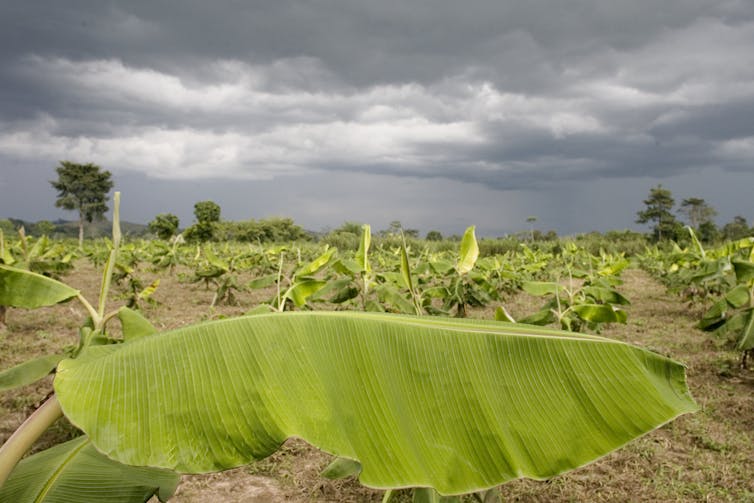
A banana field in the Democratic Republic of the Congo. giulio napolitano/Shutterstock
If the trade war escalates, farmers in these regions may be forced to abandon staple crops for cash commodities such as cocoa or coffee, deepening their reliance on volatile global markets and reducing their food self-sufficiency. Global inequality will worsen unless things change.
One option would be to protect essential agricultural imports, especially fertilizers and staple foods, from punitive tariffs. This would stabilise prices and protect vulnerable economies. The recently announced 90-day pause for negotiations offers a glimmer of hope, but it must be used wisely to build a more equitable trading system.
In the long term, developing countries need to bolster the resilience of their food systems. My research recommends investing heavily in mechanised agriculture which is resilient to climate change, incentivising farmers with government support, and strengthening regional trade.
The global food system is heavily interconnected. Decisions made in Washington can quickly affect food prices in Lagos, Cairo and New Delhi. And if tariffs go unchecked, they may unleash a silent and subtle crisis – one measured not in GDP, but in millions of empty stomachs.







