


 XRP Ledger Hits 10 Million AI Payments as Bitcoin Retreats
  Citi Raises Bitcoin Target to $113,000 as Crypto Outlook Improves
  SoftBank Shares Fall After $10 Billion OpenAI Investment
  Stellar Leads RWA Tokenization Growth With $36.4M Inflow
  Tencent Signs $7 Billion Oracle AI Chip Lease Deal
  TD Cowen Starts SpaceX at Buy, Sees AI Compute Driving Growth
  Goldman Sachs Names CATL, Zenergy Top China Battery Picks
  MSTR Stock Rises 3% as Strategy Challenges MSCI Bitcoin Stance
  WordPress Malware Uses Ethereum to Evade Removal
  Chainalysis AI Traces $387M Bitget Hack in Under 10 Minutes
  Citi Raises Bitcoin Price Target to $113,000 on ETF Optimism
  Micron Forecast Tops Estimates as AI Memory Demand Stays Strong
  Midnight NIGHT Token Surges 86% as Smart Contract Launch Nears
  Nvidia China Chip Sales Report Sends Chinese Semiconductor Stocks Lower
  Europe’s AI Data Centre Boom Strengthens Case for Nuclear Power
  AI Agents Could Disrupt Financial Services, Bernstein Says
  AAVE, PUMP, WLD and SKY Rally as Crypto Market Slips


 Add as a preferred source on Google

Apple has started the new year by disappointing investors with its first profit warning in 17 years. The company said that poor sales of its latest range of iPhones has helped to weaken its first financial quarter (September to December 2018). Apple now expects revenues of US$84 billion (£66 billion) with a gross profit margin of 38%, having initially expected between US$89 billion and US$93 billion. In the same quarter last year, Apple brought in US$88.3 billion on a gross margin of 42%.
This revision caused the company’s stock to drop 10% to its lowest level in 21 months. It is time to find culprits, and I will not be surprised to see headlines like, “Tim Cook is not up to the Job(s)” or: “Seven years after Jobs’ death, Apple is starting to rot.” We mustn’t believe them, however.
The reason why is explained in The Halo Effect, which was published by my colleague Phil Rosenzweig in 2007 – in my opinion one of the most important books in the history of management. Phil argues that perceptions of performance contaminate the assessments that we make about managers and leaders. He uses several examples, from Lego to Cisco to ABB, to show that a leader’s skills do not affect a company’s performance in a significant way.
When a company performs well, we tend to evaluate its leader in way that is too positive. This induces us to attribute stellar performance to certain leadership skills. So, in the case of Steve Jobs, many will eulogise his visionary perfectionism, and the great risks he took in reinventing consumer electronics categories. Yet the evidence doesn’t back this up.
The dirty truth
The one academic paper that has done a decent (econometric) job of identifying and quantifying the effect of individual leadership in corporate performance is this one from 2003. The two professors, Marianne Bertrand and Antoinette Schoar, from University of Chicago and MIT respectively, calculated that individual chief executives only contribute to between 2% and 4% of a company’s total performance.
In other words, if Apple’s profit margin is 38%, Tim Cook would be able to add or detract 1.5% at most. The same is true in reverse of Steve Jobs’ achievements during his two periods at the helm (1976-85 and 1997-2011). We can’t attribute Apple’s once skyrocketing stock to his tenure because we don’t know what the alternative best-case scenario would have been.
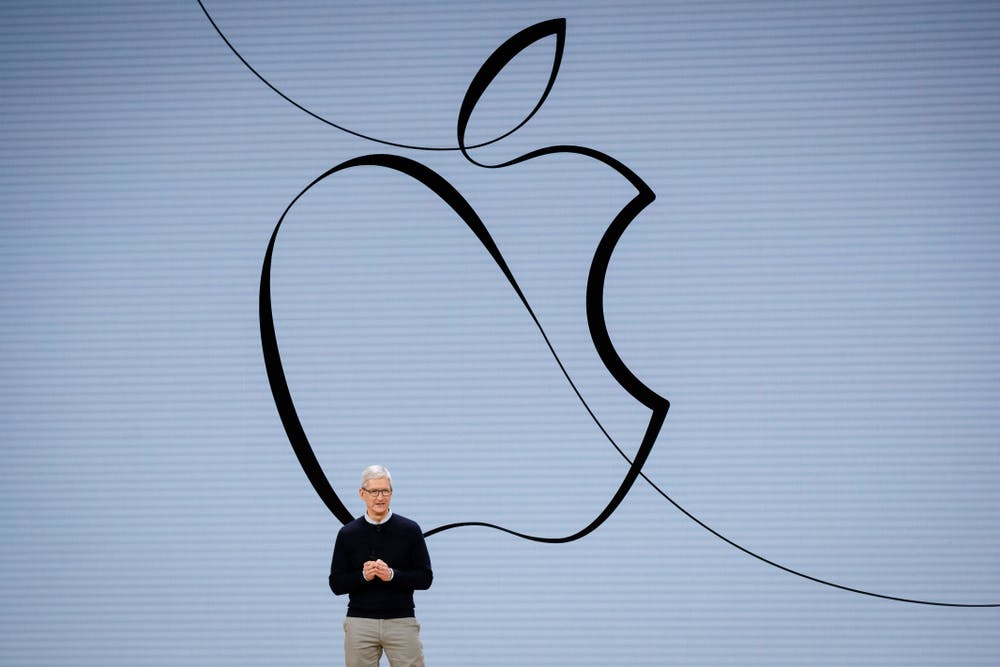
Cook who’s talking. John Gress Media Inc
In my view, Apple’s problems are primarily caused by external events. Cook explains in his recent letter that, with the exception of the services business – which includes the App Store and iTunes and accounted for 14% of revenues in financial 2018 – all the other Apple businesses will be “constrained”. This means Macs, iPads, iWatches but most importantly iPhones, which accounted for 62.7% of total Apple revenues in 2018, compared to 63.4% in 2016.
What is causing this constraint? The increasing competition from Chinese manufacturers such as Huawei and Xiaomi – but also from Google, LG and Samsung – has eroded the once dominant position of Apple in the smartphone market. Competition has been particularly damaging in emerging markets, which Cook is blaming on a strong dollar and weaker macroeconomic conditions – as opposed to any faulty Apple strategy in this part of the world.
With respect to markets where the iPhone has enjoyed a more dominant position – especially the US – Apple recognises that customers don’t replace their devices as often as they used to. A recent report by BayStreet Research estimated that, while the average user upgraded her iPhone every 24 months as recently as 2015, by the last quarter of 2018 this holding period had jumped to 36 months.
This is due to fewer carrier subsidies, according to Apple – but also, in my opinion, to the fact that the new devices do not have much more to offer. I use an iPhone 7, which I bought in 2016, and I am honestly not inclined to spend US$1,000 for I-am-not-sure-which new features on a newer version. I already get much more from my current device than I need.
Apple’s problem
It worries me that Apple is a single-product company. Among its other revenues, iPad sales are one-tenth of iPhone sales eight years after tablets were launched. By comparison, Samsung mobile phone sales only represent 36.6% of its total revenues. Wearables by Apple are not taking off either – and the company is not monetising its platform business by selling customer data to the same extent as digital rivals such as Google, Amazon and Facebook.
As I argued in an article in The Conversation a few weeks ago, the decline in Apple stock in recent months, down 37% since August 2018, reflects a change in market perception about the company’s ability to grow. Apple is no longer seen as a growth stock, but rather a dividend-paying, profitable company whose value is less based on a bright future than what is currently being delivered to its shareholders. The new financials confirm this view.
Apple share price, 2010-19

As Phil Rosenzweig explains in his book, Apple’s story is not a new one. Today we blame the current Apple management’s over-dependence on a single product for the problems with investors. Cook and his team will respond by diversifying through acquisitions, or betting more heavily on new territories, or even staying put with its current product offerings.
Whether this works or fails, the management’s style of leadership will probably be disproportionately praised or criticised. It is always easy for analysts to be wise in hindsight. But the reality is that even the world’s biggest businesses are more vulnerable to external forces than we like to think. However the leadership reacts and, whoever is at the helm, the effect is actually quite limited.







