


 Wall Street Slides as AI Stocks Tumble Following South Korea Tech Sell-Off
  South Korea’s KOSPI Rebounds as Samsung and SK Hynix Lead Tech Stock Recovery
  US Dollar Hits One-Year High as Hawkish Fed Outlook Overshadows Middle East Developments
  Russian Stocks End Flat as MOEX Index Hits New 52-Week Low
  China Keeps Loan Prime Rates Unchanged for 13th Straight Month as Policymakers Prioritize Credit Demand Recovery
  U.S.-Iran Diplomacy Helps Drive Gasoline Prices Down 15% From May Highs
  Singapore Inflation Stays Muted in May as Core CPI Misses Forecasts Ahead of MAS Review
  Dollar Holds Firm as U.S.-Iran Talks Ease Tensions, GBP/USD Slips Amid UK Political Uncertainty
  Japan, U.S. Discuss Yen Weakness as Currency Intervention Concerns Grow
  Gold Price Rises as Investors Weigh U.S.-Iran Talks and Fed Policy Outlook
  Today’s space race could turn fatal if we don’t agree on new rules
  Wall Street Ends Mixed as Alphabet Slumps, Middle East Developments and Fed Outlook Weigh on Markets


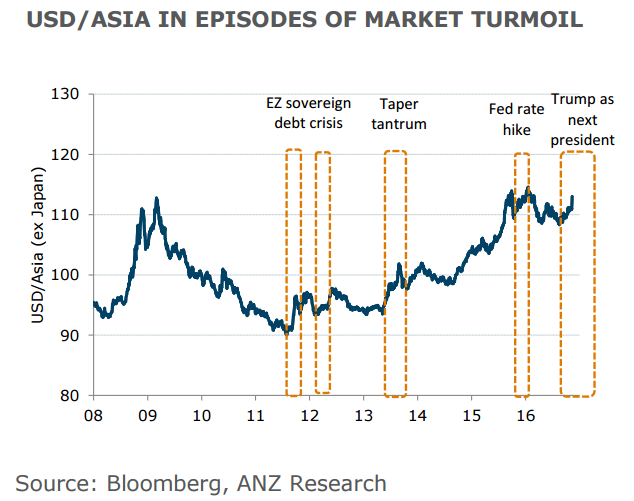
A Trump administration will present challenges to both Asian currencies and bonds. Trump’s pro-US growth and pro-fiscal stimulus economic policies coupled with a protectionist stance on global trade is a major setback particularly for trade-reliant countries like Singapore, Malaysia, Thailand, Taiwan and South Korea. Countries like Indonesia and India which are more domestically driven economies are likely to be less impacted.
Trump’s election proposals, which are pro-US growth supported by fiscal spending, will ultimately underpin the US economy, further boosting employment and wage growth. With U.S. labour market already close to full employment, it will push US inflation higher, meeting the US Federal Reserve’s dual mandate sooner than expected. Market pricing of a Fed rate hike at December meeting has risen to 80 percent after the elections and 36.8 percent of another 25bp hike by December 2017).
"We think there is a significant under-pricing of rate hikes beyond 2016. Our current house-view is for two 25bp hikes in 2017," said ANZ in a report to clients.
Asian region witnessed strong capital inflows of around USD39bn in the first nine months of the year on the back of the easy monetary policies of global central banks. The large portfolio flows into the region this year is at risk of a reversal as further monetary accommodation is now in doubt.
KRW and MYR are risk-sensitive currencies which are most vulnerable. RMB, together with the SGD is likely to lose further ground in trade-weighted terms. Asian bonds are also to come under pressure, extending the recent sell-off. Unlike in the previous episodes when Asian currencies rebounded swiftly after a short period of sell-off, the fall in Asian currencies this time round will most likely extend through 2017.
FxWirePro's Hourly Currency Strength Index was showing USD strength at +81.4924 at around 1245 GMT.







