


 Ukraine minerals deal: the idea that natural resource extraction can build peace has been around for decades
  Extreme heat, flooding, wildfires – Colorado’s formerly incarcerated people on the hazards they faced behind bars
  Rice feeds billions of people – but its role in fueling climate change is growing
  Morgan Stanley Names BAE Systems Top European Defence Stock Despite Lower Price Target
  Wildfires ignite infection risks, by weakening the body’s immune defences and spreading bugs in smoke
  Thousands of satellites are due to burn up in the atmosphere every year – damaging the ozone layer and changing the climate
  As the Black Summer megafires neared, people rallied to save wildlife and domestic animals. But it came at a real cost
  Lake beds are rich environmental records — studying them reveals much about a place’s history
  Despite its best efforts, Iran won’t be able to toll the Strait of Hormuz. Here’s why
  Parasites are ecological dark matter – and they need protecting


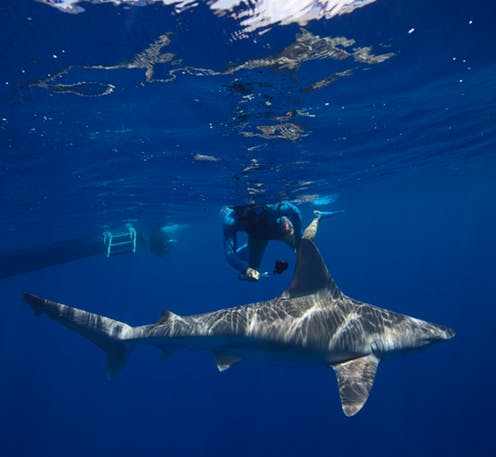


Shark ecotourism can change people’s attitudes about sharks and make them more likely to support conservation projects – even after allowing for the fact that ecotourists are more likely to be environmentally minded in the first place.
In our research, published in the journal Marine Policy, we surveyed 547 participants in a shark ecotourism program oriented towards education and conservation off the coast of Oahu, Hawaii.
We looked at participants’ knowledge of and attitudes towards sharks, and their intention to engage with shark conservation projects before and after the tour. We then compared these with the knowledge, attitudes, and conservation intentions of 488 members of the public who had not taken part in shark ecotourism.
Even before taking part in the shark ecotourism program, participants were generally more environmentally minded, more knowledgeable about sharks, and had more positive attitudes towards sharks than the general public.
For example, 71% of participants had positive attitudes towards sharks before the tour, compared with only 45% of the general public. To a certain extent, therefore, the shark ecotourism program was attracting people who were already “converted” to environmentalism.
But, crucially, we also found that after the ecotourism program, participants had significantly more knowledge of the ecological role of sharks and a more favourable attitude towards them. There was a 39% increase in knowledge along our measured scale, and 97% of participants who held negative attitudes ended up changing their mind about sharks as a result of the tour.
Ultimately, the program had a significantly positive effect on people’s intentions to engage in shark conservation behaviour, despite them already being more environmentally minded than the general public. In other words, these programs are not just “preaching to the converted” – they really do improve people’s engagement with conservation.
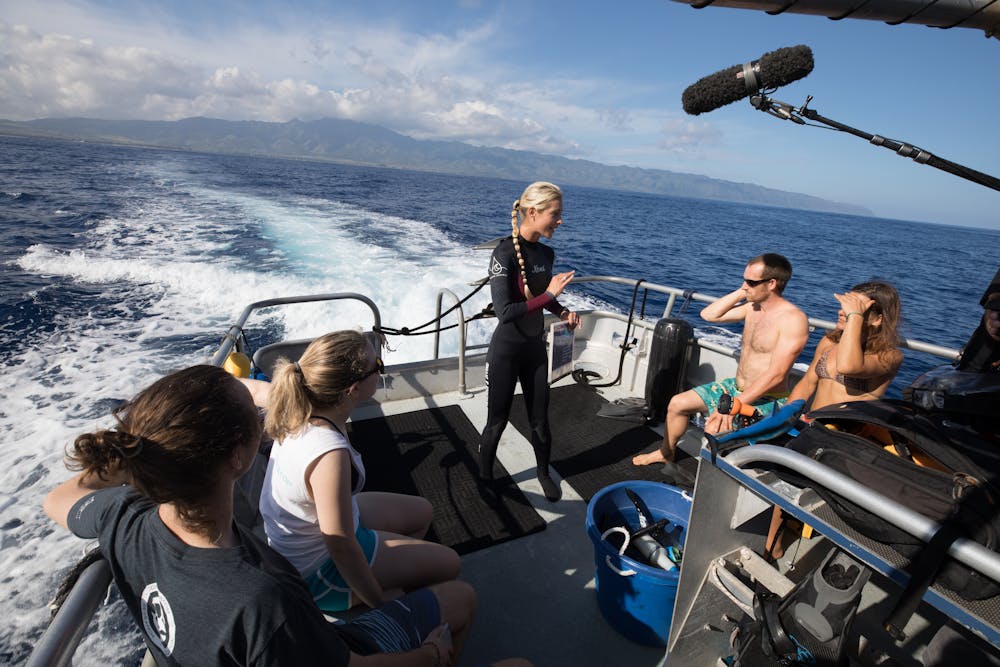
Learning to love sharks? Juan Oliphant, Author provided
Sharks’ PR problem
Sharks are crucial to our marine ecosystems, yet many shark populations are in decline as a result of fishing (particularly for shark fin soup), fisheries bycatch, habitat destruction, and climate change.
To survive, sharks need a coordinated global conservation effort. And for that they need people to speak up for them.
Unfortunately, sharks have a PR problem. They are feared by many members of the public, demonised by the media, treated as human-hunting monsters, and cast as the villains in blockbuster movies like Jaws and The Meg. In many places, government-funded programs actively cull sharks in the name of beachgoers’ safety.
Winning hearts and minds
Shark ecotourism provides an opportunity to learn about sharks’ role in ocean ecosystems, and to view and interact with them in their natural environment. Our research suggests it offers a way to counteract misconceptions and build support for shark conservation.
Not all programs marketed as shark ecotourism are equal, however. There are legitimate concerns about some forms of shark tourism, with important questions about animal welfare, ecological impacts, and public safety (particularly where chum or bait is used to attract sharks).
The conservation benefits of shark ecotourism are thus most likely to be realised when it is conducted responsibly, with trained staff, in areas that don’t conflict with other ocean uses.
Hopefully, our findings will encourage the development of responsible, environmentally friendly and educational shark ecotourism programs with specific conservation goals, which will allow people to engage with sharks in a positive way. In turn, that could help to build political and social pressure to conserve sharks.







