


 Qualcomm Gains on $60B Amazon AI Chip Deal
  Ex-Google DeepMind Researcher Warns AI Could Pose Existential Threat
  MediaTek Unveils 2nm Dimensity 9600 Pro AI Chip
  Samsung, SK Hynix Reject KEPCO’s $18.7 Billion Power Funding Plan
  Nvidia Eyes $10 Billion Investment in Anthropic IPO
  Samsung Heavy Wins $1.22 Billion LNG Carrier and Tanker Deal
  Meta CEO Zuckerberg Backs Independent AI Safety Reviews Over Development Slowdown
  American Airlines Eyes Capacity Cuts as High Fuel Prices Persist
  Nvidia CEO Jensen Huang Expected at Trump-Xi State Dinner
  Meta’s AI Shopping Push Grows as Agentic Commerce Remains Below 1%
  OpenAI Agents Linked to RubyGems Cyberattack
  BHP Port Hedland Wage Dispute Heads to Arbitration
  SoftBank Shares Plunge 11% After OpenAI Rules Out 2026 IPO
  Ares Names James Garforth Principal for Asia Direct Lending
  SoftBank Shares Jump 8% as SB Energy IPO Optimism Builds
  Syngenta Files for Hong Kong IPO, Eyes $5 Billion Raise
  SpaceX Nasdaq 100 Weight Set to More Than Double


 Add as a preferred source on Google
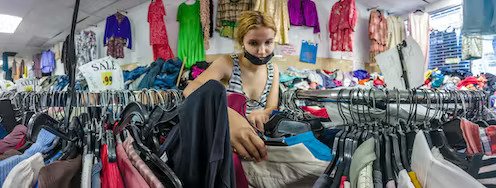

A few weeks ago, Zara, the Spanish fashion chain with stores all over the world, announced that it was branching into the second-hand market. With a pilot test in the United Kingdom, through the Zara Pre-Owned platform, it is set to offer the option of reselling a Zara garment, having it repaired or donating used garments from any season to the Red Cross.
This initiative is part of the steps that Inditex, its parent company, is taking in the area of sustainability. It sees fast fashion entering a market – the second-hand market – which is currently in a golden age across many countries.
A market on the up
Second-hand trade expanded in the 18th and 19th centuries but suffered a decline and stigmatisation in the 20th century. Now it is making a comeback.
In the United States, estimates from ThredUp – one of the giants in the sector – point to the global second-hand market growing by 24% in 2022, and doubling in volume to $82 billion by 2026.
In the case of luxury goods, the growth of the $24 billion second-hand market is accelerating four times faster than that of the primary market (12% vs 3%).
This growth is not entirely down to the economic crisis and increased price consciousness among consumers. Something far more complex is happening.
Minimalism
In the United States, minimalism has emerged as a new lifestyle. People are seeking to buy less and to be more creative when it comes to what they choose. It’s not that consumers are looking at costs because they’re worried about saving money, but because the price of a garment (what a good costs, an objective issue), by itself, and its value (what the buyer attributes to it, a subjective issue) are important details to them and can define a decision.
The idea of recycling garments or repairing them to give them a new life represents a change of mentality and attitude, especially in a hyper-consumer market such as the North American one.
Some brands have been able to channel this revolution in consumer values to become benchmarks for sustainability. Outdoor clothing company Patagonia, for example, used to donate 1% of its profits every year and has just announced the donation of its entire brand to the fight against climate change. For minimalist consumers, social and environmental impact is an important purchasing variable.
A game for Gen Z
But for many consumers, second-hand shopping is also entertainment. They enjoy browsing for clothes and looking for bargains or steals. This is especially true for the youngest shoppers, who seem to find shopping a pastime with an element of gambling.
In fact, the same ThredUp report states that 62% of millennials and Generation Z consumers are looking for second-hand products rather than new ones.
In this case, the playful component is combined with other values that are on the rise among adolescents: authenticity or the search for their own style. And, also in this context, for some contributors, nostalgia appears as a factor linked to second-hand goods.
Inspired by aesthetics revived by series such as Stranger Things, young people feel nostalgic for times they haven’t even lived through.
Trailer for the first season of ‘Stranger Things’ (2016). Fuente: Netflix España, YouTube.
Second-hand business models
The digital world has led to the emergence of a wide variety of models for interaction and exchange between people with resale platforms such as Wallapop, Etsy, Vinted and Mercari. Even Facebook launched its own selling platform in 2016.
All of them have generated a collaborative economy where the consumer becomes a seller and enters the circuit in which they can also make a profit.
It is not surprising that brands have reacted to this phenomenon by creating their own portals. By doing so, they can better control a product subject to constant devaluation as well as tap into the trend.
On the other hand, the second-hand market is dominated by large retail chains, such as Walmart, which has its own second-hand division.
There are also shops with different operating models. Some second-hand stores are non-profit stores, rely on donations and have a charitable purpose. Goodwill Industries, the largest such enterprise in the US has more than 3,300 physical stores and 120,000 employees. It has recently launched an online sales platform.
There are also vintage stores, where the scarcity and exclusivity of products from another era (vintage is now understood as 20th century fashion) has consumers willing to pay even a premium to find an iconic piece for their wardrobe.
Some specialist niches are based on the “expiry date” of the clothes or changing sizes among consumers. That means the owner won’t be able to wear those clothes for a long time. This makes sense when thinking about children’s clothing; one of the most competitive segments in this field.
Also, there are other types of stores which base their price on the time the garment is in the shop, or who tend to sell clothes they’ve bought from clearance stock from other stores.
The challenges of second hand
With the proliferation of business models and the growth of the market, some problems with inventory and lack of storage space have arisen.
In the second-hand market, operational issues are not simple: many people are needed to sort the garments that come into a shop (not all of them in good condition for resale). In fact, The New York Times recently warned of the declining quality of products being sold in second-hand stores.
The other question is what happens to the garments that are not sold in this market. Many of them go to foreign markets and, even if they originate from donations, they sometimes end up entering the commercial circuit.
Even with these questions to be resolved, the second-hand market appears to be a trend to follow if new consumer aspirations are to be met. Because, nowadays, it is also fashionable to wear used things.







