


 China Sets 1.25% Overnight Reverse Repo Rate Below Market Expectations
  Japan Signals Preference for Low Interest Rates as BOJ Policy Debate Intensifies
  Malaysia Central Bank Moves to Support Ringgit Amid Foreign Fund Outflows
  BOJ Signals More Rate Hikes as Inflation Risks Rise Amid Energy Price Pressures
  Mary Daly Says AI Uncertainty Clouds Fed Rate Outlook Despite Restrictive Policy
  Denmark Central Bank Intervenes to Support Krone Peg Against Euro
  BoE Policymaker Alan Taylor Signals No Need for Interest Rate Hike Amid Iran War Inflation Risks
  South Korea Signals Possible Interest Rate Hike as Inflation Remains Elevated


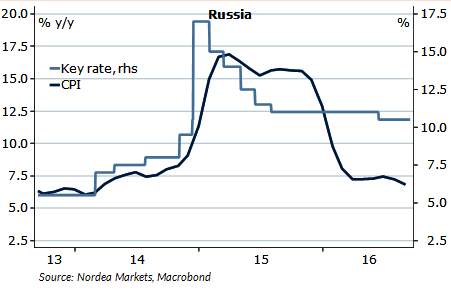
The Central Bank of Russia is due to announce its monetary policy decision tomorrow during its meeting, where it is likely to lower its benchmark rate by 50 basis points that might have a tad of a negative impact on the Russian ruble, said Nordea Bank in a research note. Consensus expectations are also for the Russian central bank to cut rates by 50bp.
The nation’s annual inflation decelerated to 6.9 percent by the end of August, while consumer prices remained flat in the initial week of September. Therefore, inflation slowed more than anticipated in August and is likely to further fall to around 6.4 percent to 6.5 percent in December, added Nordea Bank.
Furthermore, the survey if inflation expectations carried out in August for the CBR by the Public Opinion Fund showed that one-year forward expected inflation dropped to the lowest level since October 2014. This is another positive factor that underpins the view of rate reduction in September.
Meanwhile, Russia’s economic growth continues to stay negative. The Ministry of Economic Development projects the nation’s economy to shrink 0.5 percent to 0.6 percent this year. This is a tad more negative than its earlier estimate. However, it still expects recession to end during the second half of the year. Industrial production dropped in July by 0.3 percent year-on-year; however, it is likely to have come in positive in August. Thus, even if there are indications of stabilization, economic conditions continue to be discouraging, according to Nordea Bank.
With the outlook for lower inflation and a subdued economy in the medium term, the CBR is likely to lower rate at ease one more time before the end of the year. The Russian ruble might have a bit of a negative effect to tomorrow’s rate decision.
“We expect the RUB to trade in the 65-65.5 range following the rate cut. Most prime rates could continue to decrease towards 10.0 percent during the coming months”, stated Nordea Bank.

- News

- Economy

- Central Banks
- Investing
- Research
- Roundups
- Digital Currency
- Insights
- Technical Analysis
- Technology
- Business
- Law
- Health
- Nature
- Fintech
- Science
- Topic
- Opinions
- ©Econometrics LLC . All Rights Reserved.
Russian central bank likely to lower key rate by 50bp on Friday
Thursday, September 15, 2016 6:35 AM UTC
Editor's Picks



- Market Data
Most Popular




