


 Gold Prices Hold Steady Ahead of Trump-Xi Summit, Middle East Risks
  France Debt-to-GDP Ratio Seen Hitting Record 119.3% in 2026
  US-China Talks Target AI, Tariffs Ahead of Trump-Xi Summit
  Asia Stocks Rise on AI Demand as Oil Eases
  Canada Unveils Bill to Fast-Track Major Resource Projects
  Yen in Focus as BOJ, Fed Rate Hikes Reshape Currency Markets
  Oil Prices Rise as Houthi Strikes on Riyadh Fuel Middle East Tensions
  Canada Eyes India Trade Deal by Year-End
  Gold Prices Slip as Strong Dollar and Hawkish Fed Pressure Bullion


 Add as a preferred source on Google
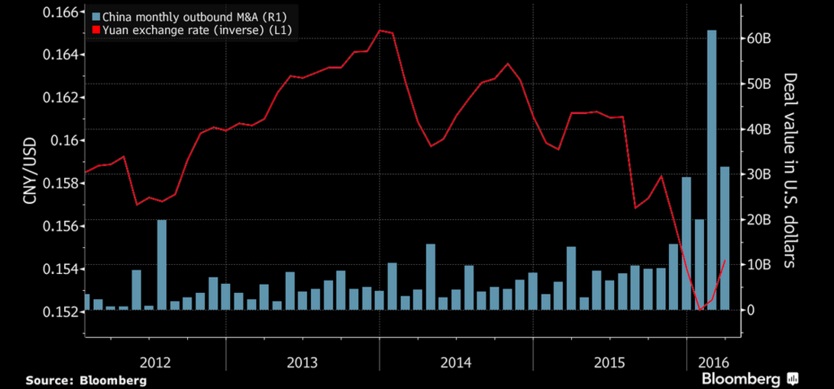
Chinese billionaires and conglomerates are gobbling up foreign entities this year like never before, triggered possibly by slowdown of domestic growth and weakness in Yuan. Even State Owned Enterprises (SOE) have joined the party.
Trend has been very much prominent since last December. Since then Chinese companies have poured in almost $150 billion to acquire overseas assets. In 2016, alone, in just three months, deal value is approaching $100 billion, which is just shy of total $106 billion for whole 2015. Appetite is very high for US based companies, which has already received bids, worth $38 billion (approx.), which is almost equivalent to the amount combined for last three years.
China’s Anbang Insurance Group has turned out as one of the big bidder. It has so far spent $2 billion on New York’s Waldorf Astoria, further $6.5 billion for hotels from Blackstone group and offered $14 billion to acquire Starwood Hotels and Resorts worldwide.
While acquisitions in itself are not concerning and many a times being seen as the acquiring companies’ economic prowess, however in this buying frenzy, it is concerning as Chinese companies are highly leveraged. Moreover, prices that are being paid may be too high, 33 times the earnings and History has shown many a times, corporations end up acquiring at market cycle top. Recent sell offer by India’s Tata Steel of UK business is excellent example of such. Tata acquired those assets during 2007-08 peak. Examples are plenty in China too. In last acquisition spree, Chinese state owned enterprises gobbled up mining assets worldwide at the cycle peak and now stands devastated.
Examples of other booming economies can also be examples. Back in 80’s Japanese economy was booming and its companies gobbled up lots of foreign assets in a buying frenzy, ultimately paying very high and finally ending up almost $400 billion loss.
If Chinese investments of Today, falls into this same pit, it will only add to the economic wreckage.
Chart courtesy Bloomberg and SoberLook.







