


 Weight-Loss Drug Ads Take Over the Super Bowl as Pharma Embraces Direct-to-Consumer Marketing
  SpaceX Prioritizes Moon Mission Before Mars as Starship Development Accelerates
  Uber Ordered to Pay $8.5 Million in Bellwether Sexual Assault Lawsuit
  Nvidia, ByteDance, and the U.S.-China AI Chip Standoff Over H200 Exports
  Washington Post Publisher Will Lewis Steps Down After Layoffs
  FDA Targets Hims & Hers Over $49 Weight-Loss Pill, Raising Legal and Safety Concerns
  Missouri Judge Dismisses Lawsuit Challenging Starbucks’ Diversity and Inclusion Policies
  Sony Q3 Profit Jumps on Gaming and Image Sensors, Full-Year Outlook Raised
  Prudential Financial Reports Higher Q4 Profit on Strong Underwriting and Investment Gains
  OpenAI Expands Enterprise AI Strategy With Major Hiring Push Ahead of New Business Offering
  CK Hutchison Launches Arbitration After Panama Court Revokes Canal Port Licences
  Nvidia CEO Jensen Huang Says AI Investment Boom Is Just Beginning as NVDA Shares Surge
  TSMC Eyes 3nm Chip Production in Japan with $17 Billion Kumamoto Investment
  Tencent Shares Slide After WeChat Restricts YuanBao AI Promotional Links
  Amazon Stock Rebounds After Earnings as $200B Capex Plan Sparks AI Spending Debate
  Nasdaq Proposes Fast-Track Rule to Accelerate Index Inclusion for Major New Listings




Puzzle fans are hooked on Connections, the latest word game from the New York Times that launched in June 2023, following the success of Wordle. The premise of the Connections game is deceivingly simple: from a grid of 16 words, find four groups of four that each have something in common. So why does this game spark so much delight and frustration among players?
To solve Connections puzzles, players need to draw on different aspects of word knowledge like a word’s meaning, grammar (e.g. a noun or verb), and how the word is spelled or pronounced. This information is stored in what cognitive scientists refer to as our semantic memory. Our word knowledge is structured through associations that reflect different types of information and are formed through experience.
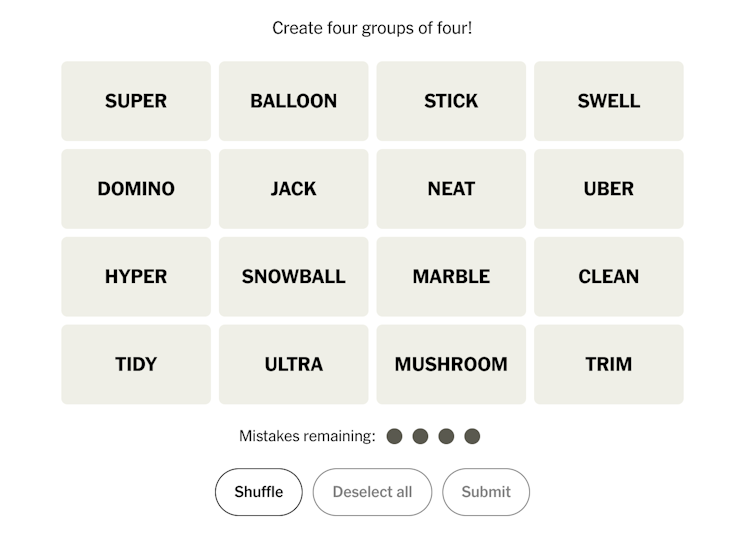
The Connections game on April 12, 2024. (New York Times)
Games like Connections require players to be flexible in how they access information in semantic memory in order to find new or remote associations between words. This involves creative thinking. More creative individuals have their semantic memory structured in a way that aids their ability to see novel connections.
Knowing how we retrieve word information can help Connections players avoid red herrings in the daily puzzles. Let’s examine some of the common types of solutions in the game and how they are related to storing and retrieving information in our semantic memory.
Synonyms
The easier puzzles (yellow and green) often require players to find words that have the same meaning. For instance, in the group: departed, left, split, went, the words are synonyms for “exited” (solution from March 28, 2024). This type of association can be developed through language experience. We hear or see thousands of words each day, and over time we learn that certain words tend to occur together or occur in similar contexts.
New York Times puzzle editor, Wyna Liu, talks about the word puzzle game Connections.
Cognitive scientists have quantified this similarity by using learning algorithms on large data sets of written and spoken natural language. These algorithms can predict human performance in tests of language processing such as semantic priming, where people are faster to recognize words that are preceded by a closely associated word (like recognizing “butter” if it is preceded by “bread”).
Semantic priming can help us quickly recognize related concepts, but it can also distract us from the puzzle’s solution. For example, the puzzle on March 23, 2024 included the words credit, discover and visa. These words are associated, in that Discover and Visa are types of credit cards, however the game solution had these words in different groups that required players to access a different meaning. Players need to be careful not to be distracted by semantic primes that do not lead to puzzle solutions.
Shared features
Shared features are another way the mind organizes knowledge. We know this because people are faster to make decisions about a word if they first briefly see a different word that shares similar features. People are also faster to recognize the unique features of things than features that are less distinctive. For example, hopping is a very distinctive feature of kangaroos and rabbits whereas having feet is not.
Words in the game are often grouped together based on shared features or attributes. For example, in the group: anise, fennel, licorice, and tarragon players needed to identify the shared feature of “similar flavour” (solution from March 13, 2024).
When deciding if words share features in the game, players may need to think beyond distinctive or defining features that are the fastest to come to mind. The solution might involve a feature that is less distinctive for the given word, which makes these types of groups more challenging to solve.
For example, a puzzle on March 28 included the words ATM, casino, schedule and spatula in the category “things with slots.” Although all these items can have slots, slots are not necessarily a defining feature of a spatula. Fans of the game have expressed frustration when solutions involve these less defining features.
Multi-word phrases
More difficult puzzles (blue and purple) often require players to recognize that the four words can form phrases if combined with another word. For example, in the group: charley, crazy, dark and gift players needed to realize that each word can be paired with the word horse to create a phrase or idiom.
These puzzles tend to be more difficult because, while idioms such as “gift horse” can be directly retrieved from our semantic memory, it may be more effortful to retrieve the meaning using the individual words that comprise the idiom. Research shows that common phrases and idioms become unique entries in our memory, and their meaning is greater than simply the sum of their parts.
Puzzles involving synonyms or shared features can be solved by focusing on the meaning of the words that are presented. However, this strategy may cause difficulty when trying to solve puzzles that involve the creation of phrases or idioms, or when the solution involves identifying connected words hidden within the presented words.
Players who find themselves stuck on a blue or purple puzzle may want to focus less on the meaning of the presented word and more on the spelling of the words or thinking about what words or letters can be added to form new meanings.
Word games like Connections reflect the structure of our semantic memory. That structure helps us find solutions but can also interfere with our ability to make the more remote or novel connections the game sometimes requires. By considering the science behind how we associate words in our minds players can adapt their strategies to forge the easy and the difficult connections.













