


 US Futures Rise as Investors Eye Earnings, Inflation Data, and Wildfire Impacts
  S&P 500 Relies on Tech for Growth in Q4 2024, Says Barclays
  U.S. Stocks vs. Bonds: Are Diverging Valuations Signaling a Shift?
  Indonesia Surprises Markets with Interest Rate Cut Amid Currency Pressure
  Moody's Upgrades Argentina's Credit Rating Amid Economic Reforms
  Moldova Criticizes Russia Amid Transdniestria Energy Crisis
  European Stocks Rally on Chinese Growth and Mining Merger Speculation
  U.S. Banks Report Strong Q4 Profits Amid Investment Banking Surge
  Gold Prices Fall Amid Rate Jitters; Copper Steady as China Stimulus Eyed
  Bank of America Posts Strong Q4 2024 Results, Shares Rise
  UBS Predicts Potential Fed Rate Cut Amid Strong US Economic Data
  Urban studies: Doing research when every city is different
  Stock Futures Dip as Investors Await Key Payrolls Data
  U.S. Treasury Yields Expected to Decline Amid Cooling Economic Pressures
  UBS Projects Mixed Market Outlook for 2025 Amid Trump Policy Uncertainty
  Mexico's Undervalued Equity Market Offers Long-Term Investment Potential
  Oil Prices Dip Slightly Amid Focus on Russian Sanctions and U.S. Inflation Data


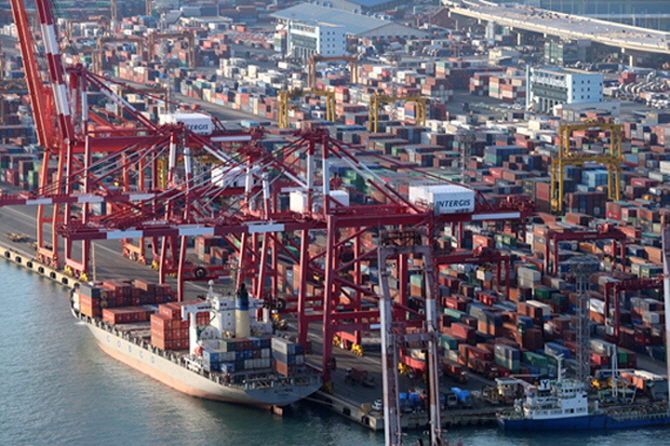
Moody's says the credit quality of non-financial corporates in Korea (Aa2 stable) will be stable in 2016, but that weak macroeconomic conditions will increase challenges for some sectors.
"Despite significant macroeconomic-related challenges, we expect the financial leverage for most of our rated Korean companies to remain broadly stable in 2016, driven by their austerity efforts as well as steady earnings from the lower base in 2015," says Chris Park, a Moody's Associate Managing Director.
However, the financial leverage for some companies in the retail, steel, and technology industries should remain elevated or deteriorate further after weakening in 2015.
"The weakening for some of these companies mainly stems from earnings pressure amid unfavorable industry fundamentals against the backdrop of weak macroeconomic conditions," adds Park.
Park was speaking on Moody's just released sector-in-depth report on Korean non-financial corporates entitled, "Credit Quality Will Be Stable in 2016, but Weak Macro Conditions Increase Challenges."
According to the report, low commodity prices will continue to have a mixed impact on Korean companies.
Industries for which fuel is a direct or significant cost will continue to see a positive effect from lower commodity prices, as it will either boost demand for their products or lower operating expenses.
In this regard, refining and petrochemical companies such as SK Innovation Co. Ltd. (Baa2 stable) and LG Chem, Ltd. (A3 stable), and power utility Korea Electric Power Corporation (Aa2 stable) will continue to benefit from the low oil price environment.
However, exploration and production companies will be hurt by the lower oil prices.
And given China's (Aa3 negative) position as the largest export market for Korea, a further slowdown in its economy will have a profound impact on Korean exporters particularly in the auto, chemical, steel and refining sectors.
Also, domestic business-oriented companies -- except for the telecommunication and utility sectors -- are not immune, as weaker Chinese growth will hamper domestic economy and consumption.
According to the report, negative rating actions will outnumber positive actions over the next 12 months; about a quarter (23%) of the rated Korean companies, excluding government-related issuers (GRIs), have negative rating outlooks, far exceeding the 9% with positive outlooks.
Upward rating pressure is limited to a few companies such as GS Caltex Corporation (Baa3 positive) and Hyundai Steel Company (Baa3 positive), whose financial profiles Moody's expects will improve.







