


 Best Gold Stocks to Buy Now: AABB, GOLD, GDX
  Brazil Weighs IP Curbs, Patent Suspensions After New U.S. Tariffs
  IEA Warns China Rare Earth Export Curbs Could Threaten $6.5 Trillion in Global Production
  Gold Prices Head for Biggest Weekly Loss Since June as Fed Rate Outlook Weighs
  South Korea’s KOSPI Enters Bear Market Despite Remaining 2026’s Best-Performing Major Stock Index
  AI Chip Stocks Face Valuation Pressure as Investors Shift Toward Big Tech and Software
  Dollar Slides as Softer US Inflation Dims Fed Rate Hike Expectations


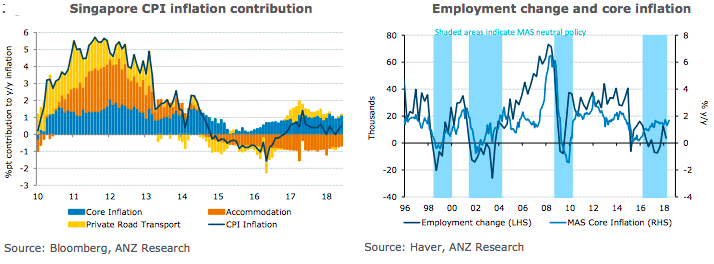
The Monetary Authority of Singapore (MAS) expects to see the county’s core consumer price inflation (CPI) to pick up towards 2 percent y/y later in the year. Based on domestic developments, a further modest tightening in October cannot be ruled out, though this will depend largely on how the external environment evolves.
The country’s CPI inflation rose to 0.6 percent y/y from 0.4 percent y/y in the previous month. On a sequential basis, CPI rose by 0.1 percent m/m in June. This was driven by higher food prices (0.2 percent m/m) and services prices – most notably holiday expenses, which increased by 2 percent m/m.
Accommodation costs appear to have halted their multi-year decline, posting a 0.1 percent m/m increase in the absence of any S&CC rebate. This suggests that accommodation costs will cease to be a drag on headline inflation on a sequential basis going forward.
Of more significance for monetary policy is the rise in core inflation to 1.7 percent y/y from 1.5 percent the previous month. This is higher than market expectations, and comes after being stuck largely within a 1.3-1.5 percent range over the previous 10 months (barring the spike driven by the tobacco tax hike in February this year). This is a further sign that improving growth is starting to filter through into price pressures, though it is still modest at this stage.
"With actual core inflation averaging 1.5 percent in H1 this year, this implies a further rise in core inflation towards 2 percent y/y later in the year. This will hinge on a continued pick-up in domestic demand and the labour market," ANZ Research commented in its latest report.







