


 Oil Prices Drop as Strait of Hormuz Shipping Recovers
  Bank Regulation Rollbacks in the U.S. and UK Could Increase Financial Risks, Study Warns
  S&P Affirms Brazil’s BB Credit Rating with Stable Outlook Amid Fiscal Challenges
  Morgan Stanley Sees Chinese Auto Market Recovery Gaining Momentum in Late Summer
  Trump Threatens 100% Tariffs on Countries Imposing Digital Services Taxes on U.S. Tech Firms
  US Dollar Slips After PCE Inflation Data as Fed Rate Hike Expectations Stay Elevated
  Gold Prices Fall Below $4,000 as Strong Dollar, Fed Rate Hike Bets Weigh on Bullion
  Asian Currencies Trade Mixed as Yen Hovers Near 40-Year Low, Dollar Holds Firm on Fed Outlook
  Iran Attack in Strait of Hormuz Pushes Oil Prices Higher
  Gold Prices Fall Amid Rate Jitters; Copper Steady as China Stimulus Eyed


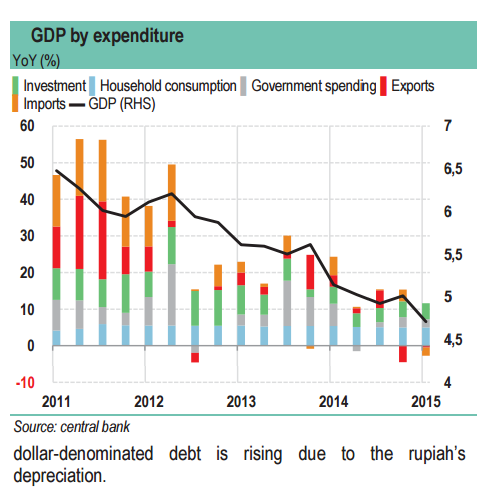
In Q1 2015, GDP growth continued to slow to only 4.7% yoy (down from 5% in Q1-2014), the slowest pace since the 2009 crisis. Household consumption remained relatively robust, but exports continued to contract for the second consecutive quarter.
The slowdown was particularly sharp in the mining industry, reflecting the decline in commodity prices, but also the contraction in production volumes following the export ban on certain unprocessed mining products since 1 January is also hurting from the economic slowdown in China, its second largest trading partner since 2009. China's share of Indonesian exports dropped from 12.4% in 2013 to 10% in 2014.
The ongoing slowdown in the Indonesian economy since 2012 can be attributed to the structure of the economy. One of its main weaknesses is its heavy dependence on commodities, even though the situation has improved over the past three years, notably due to the decline in oil production. In 2014, commodities accounted for an estimated 9% of GDP.
Commodity exports accounted for 54% of the total, and 20% of government revenues were derived from the exploitation of commodities. It is thus easy to understand why growth has slowed sharply since the drop-off in international commodity prices. As long as coal, palm oil, rubber and oil prices held at high levels, the country's economic growth exceeded 6%. Yet the World Bank now estimates its growth potential at only 5.5% if commodity prices were to hold at current levels. Even though Indonesia has become a net oil importer, the oil bill has not fallen enough to offset the impact of the decline in commodity prices on the economy as a whole.

- News

- Economy

- Central Banks
- Investing
- Research
- Roundups
- Digital Currency
- Insights
- Technical Analysis
- Technology
- Business
- Law
- Health
- Nature
- Fintech
- Science
- Topic
- Opinions
- ©Econometrics LLC . All Rights Reserved.
The slowdown continues in Indonesia
Tuesday, July 14, 2015 2:03 AM UTC
Editor's Picks



- Market Data
Most Popular




