


 Asian Stocks Rise as Softer U.S. Inflation Boosts Sentiment Despite Middle East Tensions
  ECB's Kocher Says No Inflation Spillover Yet From Iran Conflict, Warns Risks Remain
  Oil Prices Surge as U.S.-Iran Conflict Escalates and Strait of Hormuz Risks Grow
  Australia Consumer Sentiment Rises in July as Fuel Price Relief Lifts Confidence
  Australian Business Conditions Hold Steady as Easing Cost Pressures Face New Oil Price Risks
  European Stocks Slip as Middle East Tensions and Hormuz Threat Rattle Markets
  Dollar Slides as Softer US Inflation Dims Fed Rate Hike Expectations
  South Korea’s KOSPI Enters Bear Market Despite Remaining 2026’s Best-Performing Major Stock Index


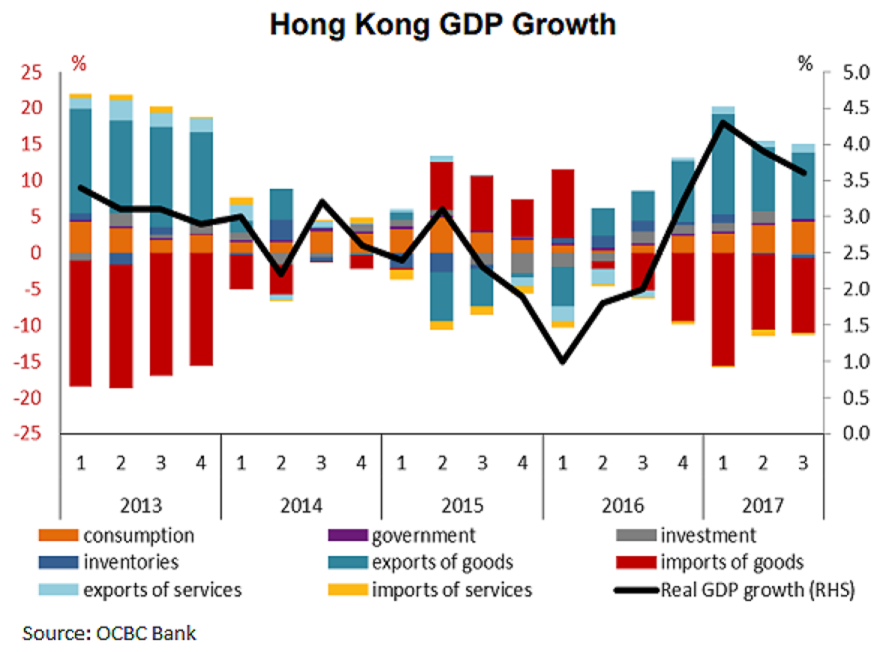
Hong Kong’s gross domestic product (GDP) is expected to expand by 2.9 percent y/y this year, according to a recent research report from OCBC Bank. As the low base effects faded, GDP growth peaked in Q1 2017 and slowed down gradually in the aftermath. However, the pace of deceleration has been much softer than was previously expected. The economy’s rosy performance was mainly driven by the global recovery, solid labor market and domestic fiscal stimulus.
The new government places great emphasis on the innovation and technology industry, in an effort to diversify HK’s economy. The proposed tax reduction for and the additional investment in the innovation and technology industry may boost the industry’s growth. Meanwhile, the government aims to promote innovation and technology development by participating in the development of the Greater Bay Area.
As China is also aiming to optimize the industrial structure according to the 13th Five-Year plan, Hong Kong’s strong research capability and the large talent pool is expected to facilitate its co-operation with Mainland China in terms of innovation and technology. This will in turn buoy growth of the Greater Bay Area.
"We expect external factors to continue supporting export of goods and tourism recovery. Tight labor market and fiscal stimulus will also keep private consumption as well as government spending and investment elevated respectively. Therefore, despite unfavorable base effect in Q4, we have revised our GDP growth forecast to 3.6 percent y/y for 2017. This will be the strongest growth since 2011. In the coming years, economic growth is likely to sustain albeit at a slower pace due to high base effect," the report added.
Meanwhile, FxWirePro has launched Absolute Return Managed Program. For more details, visit http://www.fxwirepro.com/invest







