


 China Factory PMI Seen Returning to Growth in June as AI Export Demand Supports Economy
  Canada Grants C$7 Million to Greenland Molybdenum Mine to Strengthen Critical Minerals Supply
  Economic pessimism has set in – but there are reasons for Australians to be hopeful
  China Expands Export Controls, Adds 20 Japanese Companies to Restricted List
  Yen Falls to 40-Year Low as Markets Watch Japan Intervention and U.S. Jobs Report
  China Sets 1.25% Overnight Reverse Repo Rate Below Market Expectations


The UK's October Manufacturing PMI rose to 55.5, after a marginal upward revision to 51.8 in September. The overall index was upbeat at a 16-month high, considerably above market expectations.
The output index accelerated to 58.3 (+5.2pp) as new orders recorded a jump to 56.9 (+4.0pp), its highest level since July 2014, with the subcomponent new export orders picking up marginally less by 1.3pp (to 52.0).
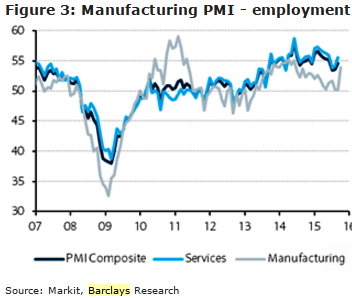
This highlights that while recently seen export orders improving at the expense of domestic orders, the release indicates domestic orders were in fact the primary driver of the resurgence. The employment index also improved considerably (+3.7pp), touching a 17-month high.
Cost pressures continued as prices remained mired in contractionary territory. Input prices posted a slight recovery but remained low at 39.7 and however declined on a 3mma/3mma basis, while output prices edged lower to 48.0 (-0.7pp).
"While the strong upside surprise is potentially welcome news for the outlook of the UK's manufacturing industry, it has not been felt across all sectors. Of concern is that this upside surprise is confined solely to large firms, according to the Markit press release, while SMEs (accounting for approximately 50% of UK GVA) reported similar levels to September or even marginal declines", says Barclays.
On employment, again the rise was due to larger firms, which reported a lack of capacity to meet orders, while SMEs reported no change in employment levels or expectations.
Further, continued weakness in input and output prices, both significantly below their long-term averages and showing continued quarterly declines, signals more inflationary weakness is in the pipeline and bodes ill for expectations of a quick normalisation in inflation towards 2%.
This is consistent with the view that October inflation will dip to -0.2% y/y from -0.1% y/y in September, and hover around 0% till the end of 2015. Overall, despite today's release, it remain cautious in light of the inconsistency among different firm sizes and sectors, and more consistency should be seen among firms before welcoming the rise.
"Furthermore, today's PMI release does not affect the view on the BoE's policy decision, a lift-off is likely by Q2 16, after the Fed's lift-off, which migth be in March 2016", added Barclays.

- News

- Economy

- Central Banks
- Investing
- Research
- Roundups
- Digital Currency
- Insights
- Technical Analysis
- Technology
- Business
- Law
- Health
- Nature
- Fintech
- Science
- Topic
- Opinions
- ©Econometrics LLC . All Rights Reserved.
Good news for UK's larger firms, less so for SMEs
Tuesday, November 3, 2015 3:14 AM UTC
Editor's Picks



- Market Data
Most Popular




