


 ETHUSD Surges Past $2700 on Strong Institutional Demand, Technicals Show Bullish Crossover Despite Cooling ETF Inflow Momentum
  AMD Hits $1 Trillion as BofA Raises Price Target to $720
  FxWirePro- Major Crypto levels and bias summary
  FxWirePro- Major Crypto levels and bias summary
  Solana ETFs Draw Record $188M Weekly Inflows as Bitwise BSOL Leads
  Bitcoin Slides Below $84K as Trump Signals Possible New Iran Strikes
  XRP Price Targets $1.70 as Bullish Momentum Builds
  BlackRock’s Rick Rieder Favors Bonds Over Stocks as Treasury Yields Surge
  Peter Brandt Sees XRP Rally Toward $5.40 as Whales Accumulate


 Add as a preferred source on Google
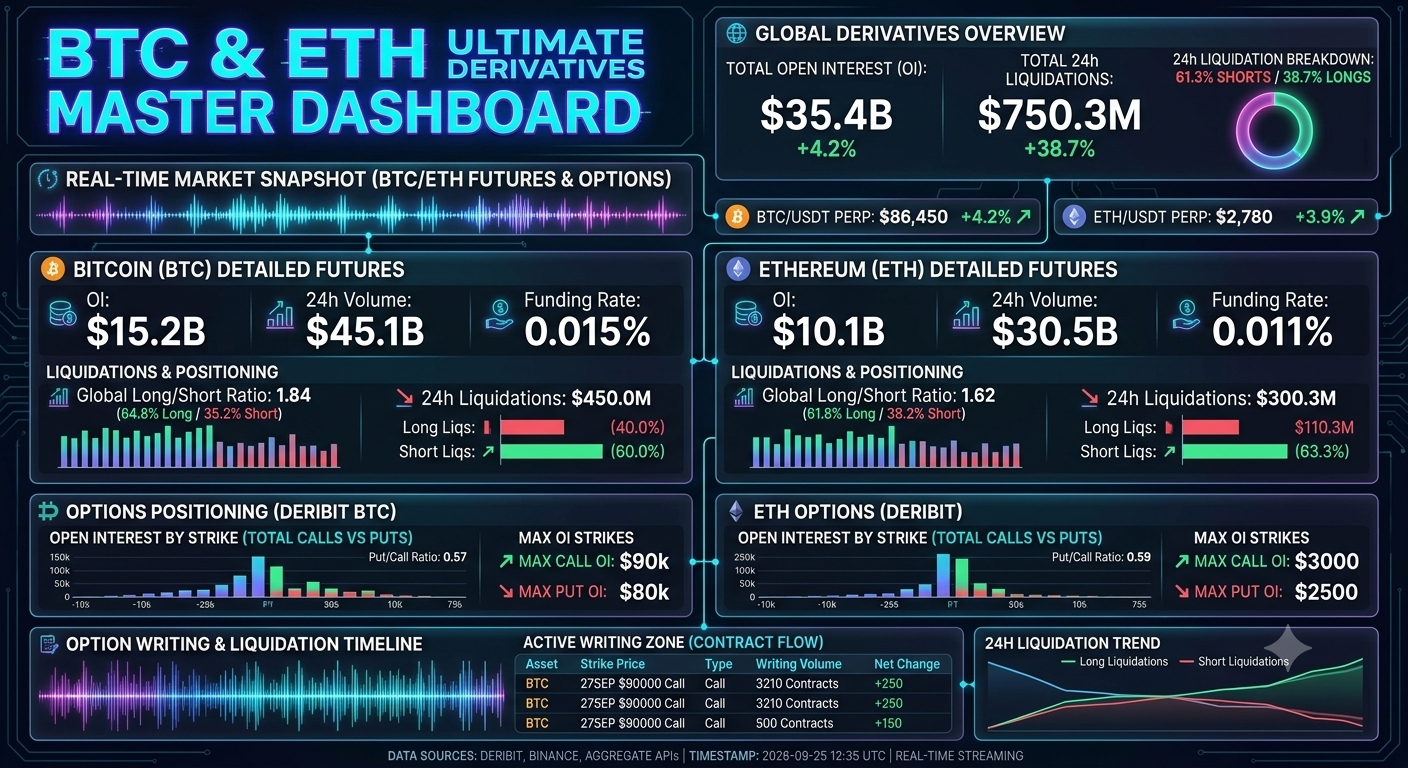
Over the past 24 hours, the crypto derivatives market saw a significant structural change as a sudden positive surge set off $750.0 million in worldwide liquidations on Bitcoin and Ethereum. With short holdings totaling 61.3% ($460.0 million) of all liquidated leverage—comprising $270.0 million in BTC shorts (60.0%) and $190.0 million in ETH shorts (63.3%)—bears suffered most of the loss. While worldwide open interest increased to $15.2 billion for BTC and $10.1 billion for ETH, this flurry of forced buy-backs drove Bitcoin up 4.2% to $86,450 and Ethereum up 3.9% to $2,780. Long accounts still predominate at 64.8% for Bitcoin (1.84 long/short ratio) and 61.8% for Ethereum (1.62 long/short ratio), with positive perpetual funding rates of +0.015% and +0.011% respectively. Account positioning remains generally positive.
Though future markets show strong long bias, institutional options positions on Deribit show definite structural limits constraining instant gains. The Put/Call ratios for BTC are a low 0.57 and for ETH are 0.59, which shows that people want a lot of call exposure. But a lot of call walls have made it very hard for the prices to go above the $90,000 strike for Bitcoin (18,450 contracts) and the $3,000 strike for Ethereum (148,000 contracts). The active option writing volume strongly favors call selling—reaching 10,210 call contracts written for BTC and 62,500 for ETH—suggesting market makers and institutional desks are monetizing increased volatility by capping short-term targets. In the meantime, big put open interest barriers at $80,000 on BTC (14,200 contracts) and $2,500 on ETH (125,000 contracts) offer strong institutional downside protection, hence defining a trading range for the next expiration cycle.







