


 Energy Sector Outlook 2025: AI's Role and Market Dynamics
  Jerome Powell Warns Against Politicizing the Federal Reserve, Defends Democratic Institutions
  BOJ Raises Interest Rates to 1% as Inflation Pressures Persist
  Japan Signals Preference for Low Interest Rates as BOJ Policy Debate Intensifies
  Trump’s "Shock and Awe" Agenda: Executive Orders from Day One
  China Keeps Loan Prime Rates Unchanged for 13th Straight Month as Policymakers Prioritize Credit Demand Recovery
  RBI Hits Pause as Geopolitical Storm Clouds Gather
  UBS Predicts Potential Fed Rate Cut Amid Strong US Economic Data
  Moody's Upgrades Argentina's Credit Rating Amid Economic Reforms
  South Korea Signals Possible Interest Rate Hike as Inflation Remains Elevated
  Indonesia Plans Higher Asset Yields to Boost Rupiah and Restore Investor Confidence
  2025 Market Outlook: Key January Events to Watch
  RBA Expected to Hold Interest Rates at 4.35% as Markets Watch AUD/USD and ASX 200


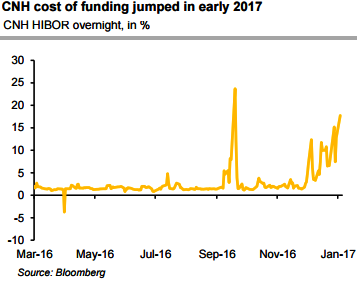
What occurred at the start of 2017 evokes the market anarchy in early 2016. This morning, Chinese offshore currency (CNH) overnight HIBOR spiked to 18.5%, a signal that China’s currency is under great pressure again. Liquidity tightening is a typical phenomenon when the currency is facing huge sell-off pressure – people borrow one currency and short, which pushes up the cost of funding.
Of course, the intervention from the central bank, if there is, will tighten the CNH liquidity as well. There is no doubt that China still faces strong capital outflows, and the reactions from Chinese authorities are to tighten the capital control measures.
This won’t sort out the problems fundamentally, as the root reason of capital outflows is the extremely expensive domestic asset prices and poor real returns of these assets.
In fact, the Chinese authorities have realized this issue and have turned its policy focus to “bubble deflating” in the coming year. This makes sense, but short-term pain is inevitable.
One should clearly understand that the recent upmove in USDCNY is largely a reflection of USD strength rather than CNY weakness. USDCNY appreciated in line with broad USD appreciation. US officials cannot reasonably claim that China is deliberately weakening CNY. A simple comparison between USDCNY and the CFETS RMB index shows that during October and November the weighted basket remained effectively flat, whereas USDCNY appreciated in line with broad USD appreciation.
On the contrary, any abrupt CNY appreciation is only deemed as the effects of the selling FX reserves to prevent severe CNY weakness.
CNH Option strategies on hedging grounds:
Buy USDCNH 1y topside seagull, strikes 6.90/7.20/7.50, zero cost (indicative, spot ref: 6.95), the structure is a standard 1y call spread strikes 7.20/7.50 fully financed by selling a put strike 6.90, exposed to a maximum USDCNH appreciation of 4.2% at expiry.
Buy USDCNH 1y call spread strikes 6.90/7.80, (spot ref: 6.9268) This longer-term trade positions for further CNH depreciation, generating a maximum leverage close to 6 times beyond 8.00 in one years.







