


 S&P 500 Relies on Tech for Growth in Q4 2024, Says Barclays
  Stock Futures Dip as Investors Await Key Payrolls Data
  U.S. Treasury Yields Expected to Decline Amid Cooling Economic Pressures
  2025 Market Outlook: Key January Events to Watch
  Global Markets React to Strong U.S. Jobs Data and Rising Yields
  US Gas Market Poised for Supercycle: Bernstein Analysts
  US Futures Rise as Investors Eye Earnings, Inflation Data, and Wildfire Impacts
  Oil Prices Dip Slightly Amid Focus on Russian Sanctions and U.S. Inflation Data
  European Stocks Rally on Chinese Growth and Mining Merger Speculation
  Gold Prices Slide as Rate Cut Prospects Diminish; Copper Gains on China Stimulus Hopes
  U.S. Stocks vs. Bonds: Are Diverging Valuations Signaling a Shift?
  Goldman Predicts 50% Odds of 10% U.S. Tariff on Copper by Q1 Close
  Urban studies: Doing research when every city is different
  U.S. Banks Report Strong Q4 Profits Amid Investment Banking Surge
  Wall Street Analysts Weigh in on Latest NFP Data
  China’s Growth Faces Structural Challenges Amid Doubts Over Data
  Gold Prices Fall Amid Rate Jitters; Copper Steady as China Stimulus Eyed


As the dust settles around the UK general election, in which PM Johnson’s Conservative Party won a healthy majority, the focus is now on the next steps for the government. Speculation remains high that Mr Johnson could announce some changes to his cabinet today, particularly to take into account those members that are no longer MPs. However, over the weekend, news reports suggest that more sweeping changes are likely to wait until after the UK leaves the EU at the end of January. Parliament is due to be summoned tomorrow, when MPs will be officially sworn in, with the Queen’s Speech due to take place on Thursday. Here, the Prime Minister will lay out his legislative agenda, with a focus on “getting Brexit done”, which will likely see the government bring the Withdrawal Agreement bill back for a vote before Christmas.
For now, the focus would be on the ‘flash’ UK PMIs for December. In the November releases, manufacturing and service sector companies noted that domestic political uncertainty had weighed on business and consumer activity. The extent to which the election result has cleared up some of this uncertainty will not be captured by these releases, given their early publication. Nevertheless, we predict improvements in both the manufacturing and services PMIs to 49.6 (from 48.9) and 49.5 (from 49.3), respectively. These levels would be consistent with a small contraction in GDP growth, though the survey has overestimated the weakness in activity this year. Our own measure of business confidence, the Lloyds Business Barometer is released on Friday.
The GBPJPY was volatile yesterday, appreciating to just shy of $146.130 after reports of a Brexit deal agreement. Currently, trading with little exhaustiveness, still, it is well up from last week’s lows.
Even so we believe it worthwhile increasing our bearish beta to GBP through re-selling GBPJPY (our single most successful trade to date this year).
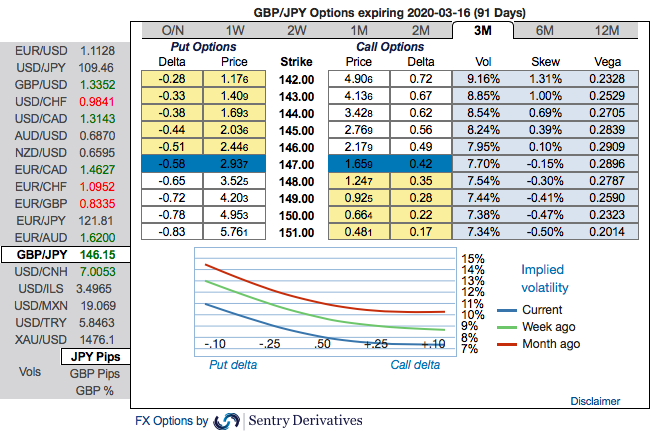
OTC outlook and Hedging Strategy: The implied volatility of this pair that display the highest number among entire G7 FX universe.
While the positively skewed IVs of 3m tenors signify the hedgers’ interests to bid OTM put strikes up to 142 levels (refer above nutshell).
Accordingly, put ratio back spreads (PRBS) are advocated on the hedging grounds. Both the speculators and hedgers who are interested in bearish risks are advised to capitalize on current abrupt and momentary price rallies and bidding theta shorts in short run, on the flip side, 3m skews to optimally utilize delta longs.
The execution: Capitalizing on any minor upswings , we advocate shorting 2m (1%) OTM put option (position seems good even if the underlying spot goes either sideways or spikes mildly), simultaneously, go long in 2 lots of delta long in 2m ATM -0.49 delta put options (spot reference: 146.18 levels while articulating).
The position is a spread with limited loss potential, but varying profit potential. The degree of profit relies on the strength and rapidity of price movement. The position uses long and short puts in a ratio, such as 2:1 or 3:2, to maximize returns. Courtesy: Sentrix & Lloyds







