


 U.S. Banks Report Strong Q4 Profits Amid Investment Banking Surge
  Bank of America Posts Strong Q4 2024 Results, Shares Rise
  Wall Street Analysts Weigh in on Latest NFP Data
  Oil Prices Dip Slightly Amid Focus on Russian Sanctions and U.S. Inflation Data
  Trump’s "Shock and Awe" Agenda: Executive Orders from Day One
  UBS Projects Mixed Market Outlook for 2025 Amid Trump Policy Uncertainty
  Gold Prices Slide as Rate Cut Prospects Diminish; Copper Gains on China Stimulus Hopes
  China’s Growth Faces Structural Challenges Amid Doubts Over Data
  Gold Prices Fall Amid Rate Jitters; Copper Steady as China Stimulus Eyed
  UBS Predicts Potential Fed Rate Cut Amid Strong US Economic Data
  Global Markets React to Strong U.S. Jobs Data and Rising Yields
  US Gas Market Poised for Supercycle: Bernstein Analysts
  U.S. Treasury Yields Expected to Decline Amid Cooling Economic Pressures
  Moldova Criticizes Russia Amid Transdniestria Energy Crisis
  Goldman Predicts 50% Odds of 10% U.S. Tariff on Copper by Q1 Close
  S&P 500 Relies on Tech for Growth in Q4 2024, Says Barclays


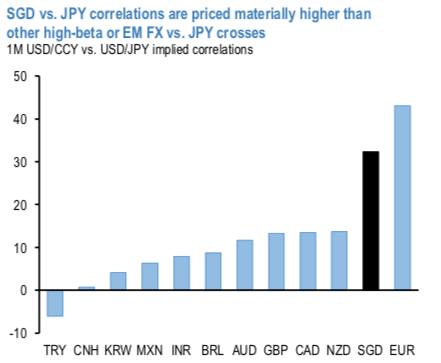
SGD vs. JPY correlations are priced materially higher than other high-beta or EM FX vs. JPY crosses on the escalation in trade tensions, Chinese retaliation with tariffs and Brexit dust with no-deal negotiation.
USDSGD vs USDJPY: Yen-cross gamma has performed like a charm over the past few weeks, most notably during the rush for exit doors on risk sparked by the break of USDCNY through 7.0, followed by the equally volatile retracement shortly after the announcement of delayed/split tariffs.
Options markets have accordingly re-priced USDJPY vs. USD/high-beta implied correlations lower / high-beta cross-yen vols higher e.g. even after this week’s partial retracement, AUD vs. JPY 1M implied corrs (+12%) are more than 20% pts. below their late-July high.
One yen-cross that defies this general rule is SGD/JPY. While the broad contours of the cross have tracked those of the rest of the JPY bloc, absolute levels of corr. are much higher (refer above chart) that make them ripe for option structures that benefit from de-coupling. Arguably, no JPY-cross correlation should be priced in positive territory in the current climate of recessionary fears, let alone in the mid-30s, and certainly not when trailing realized corrs are deeply negative (hourly 1-wk -9%, 4-wk -40%). The case for a stronger Yen in a falling US real yield, jittery risk climate is obvious; the case for a weaker SGD rests on Singapore’s high degree of exposure to the US/China trade conflict and expectations of impending MAS easing in October that informs the Asia team’s short SGD NEER stance.
Consider the following dual digital structure: 3M (USDSGD > 1% OTMS, USDJPY < 1% OTMS) costs 10% (individual digitals 26% and 37.3% respectively). Courtesy: JPM







