


 Gold Prices Fall Amid Rate Jitters; Copper Steady as China Stimulus Eyed
  Fed May Resume Rate Hikes: BofA Analysts Outline Key Scenarios
  S&P 500 Relies on Tech for Growth in Q4 2024, Says Barclays
  Stock Futures Dip as Investors Await Key Payrolls Data
  Wall Street Analysts Weigh in on Latest NFP Data
  Oil Prices Dip Slightly Amid Focus on Russian Sanctions and U.S. Inflation Data
  UBS Projects Mixed Market Outlook for 2025 Amid Trump Policy Uncertainty
  Global Markets React to Strong U.S. Jobs Data and Rising Yields
  Indonesia Surprises Markets with Interest Rate Cut Amid Currency Pressure
  2025 Market Outlook: Key January Events to Watch
  U.S. Treasury Yields Expected to Decline Amid Cooling Economic Pressures
  US Gas Market Poised for Supercycle: Bernstein Analysts
  Lithium Market Poised for Recovery Amid Supply Cuts and Rising Demand
  Moody's Upgrades Argentina's Credit Rating Amid Economic Reforms
  U.S. Banks Report Strong Q4 Profits Amid Investment Banking Surge
  U.S. Stocks vs. Bonds: Are Diverging Valuations Signaling a Shift?


The PMI in the UK has provided a first taster. The coming week’s UK PMI data (Tue-Thu) and BoE credit data (Wed) will provide further color on Q4 trends. Survey data for December so far – including GfK consumer confidence and our own Business Barometer – have seen improvements relative to November, but sharp movements in surveys since the referendum have generally tended to have little carryover to official estimates of ‘hard’ activity.
While Australia is scheduled to announce its trade balance numbers on Thursday, Australia's trade deficit was increased by 21 pct to AUD 1.54 billion in October 2016 from an upwardly revised AUD 1.27 billion in September. The figure came in below market expectations of AUD 0.80 billion gap, as exports rose 1.0 pct to AUD 27.63 billion while imports went up at a faster 2.0 pct to AUD 29.17 billion.
In the prevailing puzzled environment, you could observe that the momentary bulls of GBPAUD struggle to break and sustain above stiff resistance of 1.7769 levels, currently trading in sideways to signal some bearish pressures. Consequently, we advocate below hedging strategy with cost effectiveness that could hedge regardless of the swings on either side.
Hedging Framework:
3-Way Options straddle versus Call
Spread ratio: (Long 1: Long 1: Short 1)
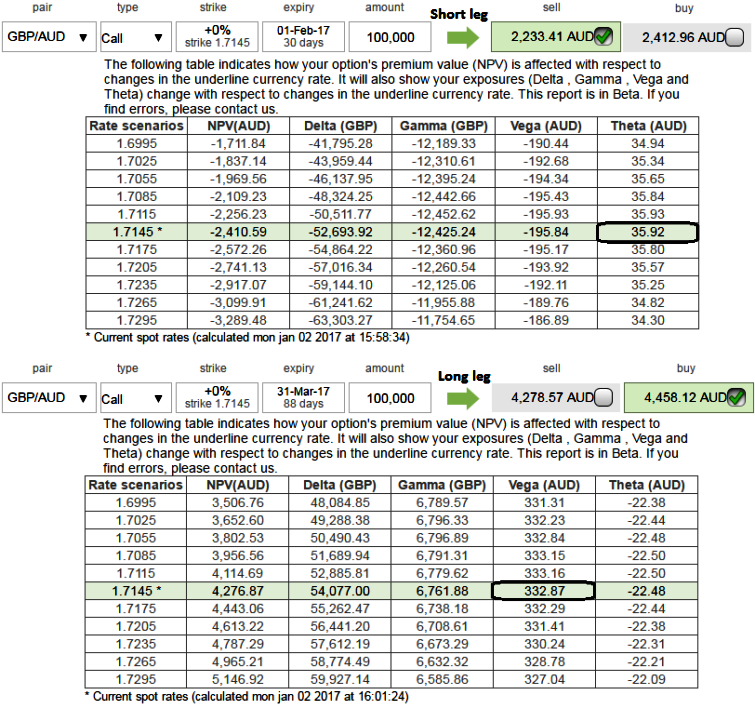
The execution: Initiate long in GBPAUD 3M at the money vega put, long 3M at the money vega call and simultaneously, Short theta in 1m (1.5%) out of the money call with positive theta or closer to zero. Theta is positive; time decay is bad for a buyer, but good for an option writer.
Rationale: As you could observe the vega of long leg (buy) call option position is 332.87 USD and it implies that if IV increases or decreases by 1%, the option’s premium would have an impact in an increase or decrease by 332.87 USD, respectively. The Vega of a short (sell) option position is negative and an increasing IV is bad.
Hence, we encourage vega longs and short thetas in the non-directional trending pair but slightly favors bearish strategy as the vega signifies the sensitivity of an option’s value owing to a shift in volatility. It is usually expressed as the change in premium value per 1% change in implied volatility.







