


 Navigating the Crypto Pulse: Weekly Market Resilience and Institutional Inflows
  RBA Set for September Rate Hike as Inflation Stays High
  Gold's Tug-of-War: Geopolitical De-escalation Fights Falling Yields as Markets Eye US CPI
  Mexico's Undervalued Equity Market Offers Long-Term Investment Potential
  UBS Projects Mixed Market Outlook for 2025 Amid Trump Policy Uncertainty
  Evernorth Nasdaq Listing Nears as XRP Price Falls
  Arthur Hayes Announces FLOP Testnet Launch Within Weeks
  U.S. Stocks vs. Bonds: Are Diverging Valuations Signaling a Shift?
  US Futures Rise as Investors Eye Earnings, Inflation Data, and Wildfire Impacts
  Crypto Derivatives Dashboard: Bulls Retain Control Amid $488M Liquidation Flush
  U.S. Banks Report Strong Q4 Profits Amid Investment Banking Surge
  Trump’s "Shock and Awe" Agenda: Executive Orders from Day One
  BNB Price Faces Pressure as DOJ Investigates Binance
  Moldova Criticizes Russia Amid Transdniestria Energy Crisis
  S&P 500 Relies on Tech for Growth in Q4 2024, Says Barclays
  Fed Unveils Stablecoin Rules Under GENIUS Act
  XRP Price Drops 3% Despite Ripple-Backed Evernorth Nasdaq Debut


 Add as a preferred source on Google
The US 10yr Treasury yields rose from 2.25% to 2.33%, and 2yr yields rose from 1.36% to 1.39%. Fed fund futures yields firmed slightly, pricing the chance of a December rate hike at around 47%.
Ahead of today’s FOMC’s meeting for the decision on funds rates, although we could see a choppy range of US dollar index for the day, some sort of bearish sensation is lingering. At present, the large majority of market participants are expecting the FOMC’s plan not to work out. That explains the current USD weakness. After its meeting today the FOMC will send out only a few signals that will convince the market of the contrary. The Fed has been amongst the central banks relying on interest rate normalization for some time.
On the flip side, RBNZ Assistant Governor McDermott spoke a few minutes ago on economic trends and its inflation target, with comments on the neutral cash rate (3.5%, which means 1.75% is stimulatory), inflation (sideways trend in core), and the exchange rate (lower would help).
Once again, we have raised the forecast profile for the NZD, as the local rates market keeps questioning the RBNZ’s commitment to its low-for-long stance and USD softness persists.
But we still expect the NZD to fall through this year, reaching USD0.67at year-end. It is hard to disagree with the central bank’s argument that the bounce in inflation to above 2%oya is tradable driven and unlikely to persist.
Even if there were an argument for much tighter financial conditions, they are already being delivered through the macro-prudential and bank funding cost channels, pushing the neutral OCR lower.
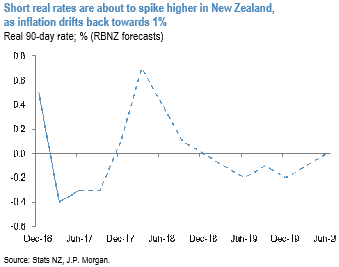
We expect that an ongoing repricing of the NZD front end through 2017 will weigh on the NZD, but some near-term support from rising real rates (as headline inflation falls over 1.0%-pts in the year to March 2018) must also be acknowledged (refer above chart).
NZ: trade balance for July expected to be a surplus, helped by lower imports.
NZDUSD technical trend sends early signs of a possible top ahead of 0.7485 (Sep 16 peak). Plenty of event risk today from McDermott, AU CPI, Lowe, and FOMC.
The RBNZ has signaled the next cycle – a tightening one – will not start until the end of 2019. That will anchor the short end, although markets will not abandon their expectations for tightening as early as mid-2018 which would mean occasional spikes in the 2yr will be likely. A 2yr swap range of 2.10% - 2.60% is expected. The long end will continue to follow US yields, which we expect to rise by year end.







