


 How AI prompting turned writerly description into an everyday skill
  Trump’s Iran Strategy: What Has Been Achieved After Three Months of Conflict?
  Sell the Bounce": Gold Rally Stalls Near $4165 as Fed Hawks Slam the Door on Rate Cuts — Targets $4000/$3600
  Mexico's Undervalued Equity Market Offers Long-Term Investment Potential
  With Iran and the US signing a peace deal, where does that leave Benjamin Netanyahu?
  UBS Predicts Potential Fed Rate Cut Amid Strong US Economic Data
  Lithium Market Poised for Recovery Amid Supply Cuts and Rising Demand
  Energy Sector Outlook 2025: AI's Role and Market Dynamics
  Goldman Predicts 50% Odds of 10% U.S. Tariff on Copper by Q1 Close
  Geopolitical Shocks That Could Reshape Financial Markets in 2025
  AI Memory Boom Sparks Global Chip Supply Crunch
  European Stocks Rally on Chinese Growth and Mining Merger Speculation
  Moody's Upgrades Argentina's Credit Rating Amid Economic Reforms
  US Gas Market Poised for Supercycle: Bernstein Analysts


As expected, RBNZ maintained status quo in their monetary policy, kept OCR unchanged at 2.25%.
But the central bank still believes that there is room for another rate cut than not in the coming months.
With economic conditions improving recently, the RBNZ shared the assessment that it was worth waiting a bit longer to make that call.
We continue to expect one more OCR cut this year, probably in the August Monetary Policy Statement.
The strength of the New Zealand dollar is a downside risk for the RBNZ’s inflation forecasts, while strong credit growth is an upside risk. Thus, we reckon that there could be a turnaround also in AUDNZD when the central bank goes hawkish in their next policy.
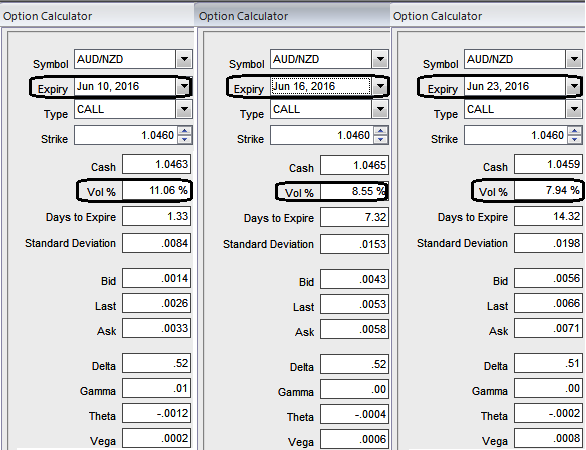
Having said that, accordingly we had recommended credit call spread strategy exactly a month ago.
We believe that the shorts in ITM calls would have certainly fetched decent yields but long calls may have gone in vain. But no worry, the portfolios was constructed on net credit so the net-to-net P&L must be positive.
We would again like to build the same strategy again resembling ITM shorts and OTM long calls, use narrow expiries (preferably 2w on the short side and 1m on the long side).
The rationale remains same, the lower strike short calls are intended because IV is on the lower side and short term trend is slightly weaker and it finances the purchase of the higher striking call (ATM calls are overpriced, so we chose 0.5% OTM calls as well) and the position is entered for nil cost.
Please be mindful of how IV shrinks away over the period of time.
Also please refer below link for our previous write up on CCS strategy; shorts have immediately reacted the moment when we advocated on 25th April:







