


 RBA Hikes Interest Rate to 4.60% as Inflation Risks Rise
  Mexico's Undervalued Equity Market Offers Long-Term Investment Potential
  BOJ Signals Faster Rate Hikes as Inflation Risks Grow
  Fed’s Logan Signals 50 Basis Points More in Rate Hikes
  ECB May Stop Rate Hikes After December, Capital Economics Says
  RBI Raises Repo Rate to 5.50% in Hawkish Shift on Inflation Risks
  Fed May Resume Rate Hikes: BofA Analysts Outline Key Scenarios
  S&P 500 Relies on Tech for Growth in Q4 2024, Says Barclays
  Visa Wins China Approval to Prepare Domestic Payments Expansion
  Moody's Upgrades Argentina's Credit Rating Amid Economic Reforms
  Trump’s "Shock and Awe" Agenda: Executive Orders from Day One
  Geopolitical Shocks That Could Reshape Financial Markets in 2025
  Australia Consumer Confidence Plunges as RBA Rate Hike Hits Households
  Fed’s Hammack Says More Data Needed Before Next Rate Move


 Add as a preferred source on Google
The Aussie dollar has been one of the worst performers in the broad-based US dollar rally since the June FOMC and ECB meetings. The Federal Reserve’s monetary policy announcement provides the focus for today. Given the FOMC raised the Fed funds rate to 2% (upper bound) in June.
The low OIS-implied probability of a hike (20%) arguably overstates the chances. While fireworks aren’t expected from the initial announcement, all eyes will be primed for any changes to the post-meeting press statement. The Fed is likely to acknowledge the strength of recent data, including the 4.1%y/y rise in Q2 GDP.
While Australia’s key commodity prices have still been broadly resilient; especially LNG and thermal coal, suggesting AUD downside should be contained multi-month. The RBA should also be optimistic about Australia’s growth outlook in its Aug statement. We look for 0.75 in near terms.
Contemplating all these drivers, AUDUSD is forecasted to slide towards 0.72 by 3Q’18. Both monetary policy divergence and minimal support from commodity prices to nudge the currency lower over time. Furthermore, the pace of domestic growth momentum is also expected to weaken in 2H’18, after a boost from net exports in the first half of the year. Recent developments around the Banking Royal Commission have likely shifted risks to that forecast to the downside.
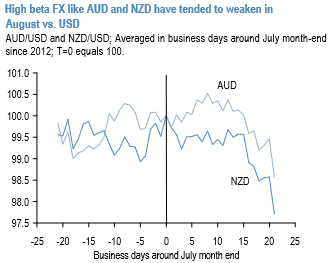
Near-term seasonals are on the margin are also supportive of the bearish view on high beta FX, as USD typically tends to strengthen in August vs high beta FX (AUDUSD and NZDUSD on average have weakened by 1.4% and 2.3% in August over the past 5-years, respectively; refer 1st chart).
Please be noted that the positively skewed IVs of 2m tenors signify the hedgers’ interests to bid OTM put strikes upto 0.72 levels (above nutshell). While we see the mild positive shift in bearish delta risk reversal indicates that the hedging activities for the downside risks remain intact amid mild momentary upswings.
We use such shifting and absolute risk reversals numbers to forecast trends and shifts in trends. Even then for more accuracy it’ is unwise to rely completely on the absolute Risk Reversal (RRs) number while devising strategies. Hence, it is better that the RRs are coupled with positively skewed IVs as diverse dynamics and the constantly changing driving forces across the globe complicate standardization of strategy rules. As you could observe the skews are well in line with the above-stated FX projections.
Currency Strength Index: FxWirePro's hourly AUD spot index has turned 114 levels (which is highly bullish), while hourly USD spot index was creeping towards at -6 (absolutely neutral) while articulating (at 10:34 GMT). For more details on the index, please refer below weblink:







