


 FxWirePro: Daily Commodity Tracker - 21st March, 2022
  China Holds Loan Prime Rates Steady for 14th Month as Economic Recovery Remains Uneven
  Brent Oil Jumps 16% for Best Week Since April as US-Iran Conflict Fuels Supply Fears
  Asian Currencies Hold Steady as Fed Outlook Offsets Middle East Tensions
  Asian Stocks Slide as Chip Selloff Deepens Ahead of TSMC Earnings
  Wall Street Ends Lower as AI Selloff, Iran Tensions Weigh on Tech Stocks
  Japan Core Inflation Seen Rising in June, Strengthening BOJ Rate Hike Outlook
  Asian Markets Cautious as Oil Tops $90, AI Earnings and Fed Rate Fears Weigh on Sentiment
  Best Gold Stocks to Buy Now: AABB, GOLD, GDX
  Asian Stocks Slide as Nikkei Leads Losses on Tech Selloff and Rising U.S.-Iran Tensions


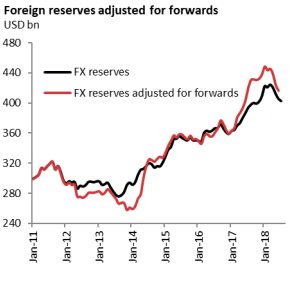
Further rise in India’s reserves this year is unlikely as foreign capital flows slow, and current account pressures resurface, according to the latest report from DBS Group Research. The balance of payments position is also to slip into small deficit of USD10-12 billion vs an accretion of USD44 billion to reserves last year.
Nonetheless, the authorities will return to build reserves as a when the macro-environment improves. As a percentage of GDP, India’s reserves have been smaller than most in the region for a few years now, which is partly the reason why the authorities have had a tendency to build buffers as and when the opportunity arises.
Reserves to external debt ratio is the next oft-discussed metric. As a gauge of near-term risk, India is well placed. Short-term external debt (based on original maturity) makes up 0.24x of total reserves as of March 2018, down from 0.34x in 2013. On residual maturity basis, the ratio of short-term debt to reserves eased from year ago but is still high at half of the reserves stock. Beyond the short-term, reserves continue to fall short of total external debt.
Between 2013 and 2018, India’s ratio has improved modestly, but is slower than regional peers signalling that vulnerability to contagion risks remain, even if the probability is lower than five years.
"As a rule of thumb, reserves between 100-150 percent of the ARA (Assessing Reserves Adequacy) are considered adequate, with the study based on a combination of vulnerability indicators, including liquidity indices, including short-term debt, resident outflows, liquidity risk etc.," the report added.
India is in the comfortable range based on this metrics. In all, despite the recent decline, India’s reserves are in a comfortable range on most metrics. Given lingering external risks, another 5-8 percent fall in reserves is probable, but is unlikely to jeopardise the adequacy math by much.







