


 Alcohol is one of the most dangerous drugs, yet its presence is ubiquitous in social settings and celebrations
  Goldman Sachs Raises USD/JPY Forecast, Sees Yen Weakness Persist Through 2027
  Gold Pulls Back After Hitting $4,180 as Geopolitical Risk Sends Crude Higher
  Buy the Dip: Gold Holds Strong at $3980, Targets $4150
  Bank of America Upgrades T-Mobile to Buy, Says LEO Satellite Fears Are Overdone
  Goldman Sachs Says China Competition Weighs More on EU Growth Than Trade Deficit
  Citi Raises TSMC Price Target as AI Chip Demand Strengthens Growth Outlook
  Gold Surges Past $4150 on Dovish Fed Signals and Weak Jobs Data; Bullish Outlook Prevails
  Elon Musk is remaking the world, like Henry Ford before him – but more dangerously
  AI can be a personal trainer in your pocket – but is it safe?


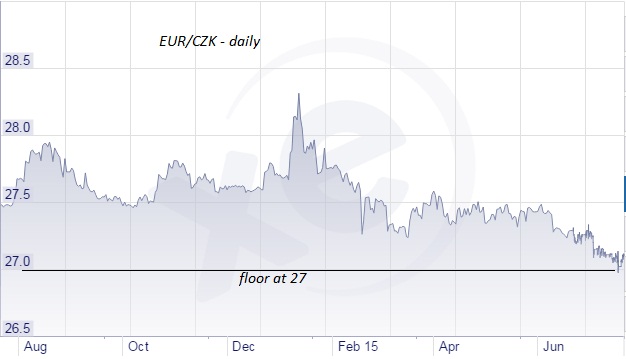
The pressure is mounting on the Czech National Bank, with Koruna testing its resolve to maintain its floor with Euro.
Yesterday, Czech National Bank has intervened to weaken the Koruna for first time since the floor was installed in 2013. The floor as of now stands at 27 Czech Koruna per one Euro.
With Czech interest rates already at bottom, central bank could be in trouble if the floor break down. A breakage is most likely to push inflation lower.
Czech economy at a glance -
- Czech GDP 206 billion, which is smaller than Greece. Growth rate is at 4% on yearly basis and 2.5% on quarterly basis, much higher than entire Euro zone.
- Central Bank's main refinance rate is at 0.05%, higher than ECB and inflation is hovering at 0.80%, higher than experienced in Euro zone.
- Unemployment rate is at 6.2%, much lower than Euro zone average.
With such contrasting fundamentals, it will be difficult for Czech Central Bank to hold the floor.
Though theoretically speaking, they can hold the floor by printing unlimited Koruna but the risk of overheating the economy will keep things challenging for Czech National Bank.
So the possibility of an early exit like SNB is clearly on the card, with ECB pumping liquidity at record pace.
Euro is currently trading at 27.07 against Czech Koruna.







