


 Geopolitical Shocks That Could Reshape Financial Markets in 2025
  Mexico's Undervalued Equity Market Offers Long-Term Investment Potential
  Moldova Criticizes Russia Amid Transdniestria Energy Crisis
  US Gas Market Poised for Supercycle: Bernstein Analysts


 Add as a preferred source on Google
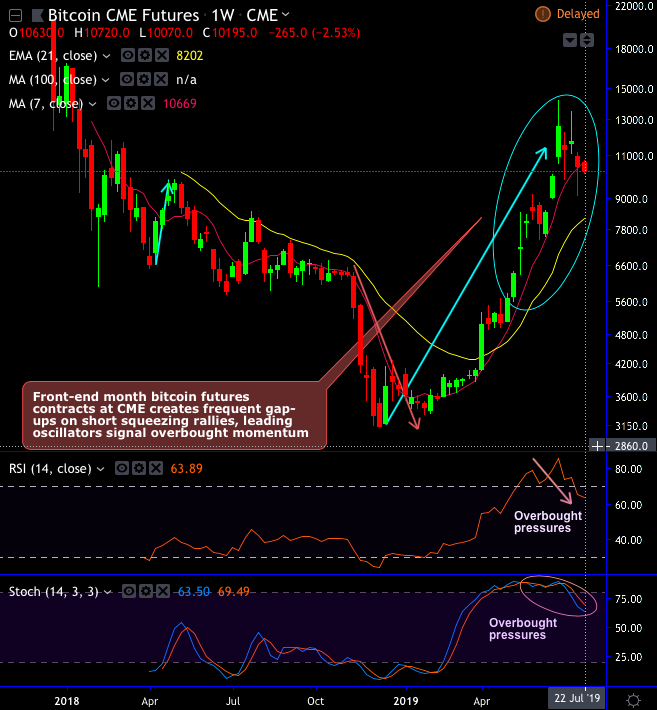
The crypto avenues have been witnessing mounting volatility in the recent past when BTC sharply surged above $13k and plunging thereafter.
When we look at the technical charts of CME BTC futures of front-end month contracts, having risen so sharply and swiftly, one can easily make out that the pioneer cryptocurrency has created considerable gaps quite often if you plot the technical charts of CME’s Bitcoin Futures contracts of near month deliveries. It is nothing new but owing to the short squeeze trading activities. Hence, the pioneer cryptocurrency plummets towards $10,200 as selling pressure ramps up.
At the time of writing, Bitcoin is trading down nearly 2% at its current price of $10,280, which is down significantly from its daily highs of nearly $10,700 that was set yesterday.
Over a one-week period, it becomes abundantly clear as to just how volatile Bitcoin has been as of late, as it dropped to lows of $9,100 last week before surging past $11,000, which was subsequently followed by a sharp selloff that has led the crypto towards its current prices.
For now, it seems that Bitcoin is likely to plummet towards the $9,000 areas, it is prudent to note that the CME Futures gap that exists around $8,500 could be a logical level for the cryptocurrency to drop to before it finds any meaningful support, we’ve reported the same in our recent post.
Now, the significant thing is that how could we interpret these futures contracts to gauge Bitcoin positioning? To know this, we apply the open interest position proxy methodology (previously applied to other futures contracts) to the above two Bitcoin contracts. The JPM’s open interest position proxy is based on the cumulative absolute change in the open interest multiplied by the sign of the futures price change every week.
The rationale behind this position proxy is that when there is a price increase, the net long position of spec investors increases also, with the magnitude of the increase determined by the absolute change in the open interest. It does not matter whether the open interest rises or falls as the net long position can increase either via fresh longs (increase in open interest) or a reduction of previous shorts (reduction in open interest).
And vice versa. When there is a price decrease, the net long position of spec investors decreases also with the magnitude of the decrease determined by the absolute change in the open interest. It does not matter whether the open interest rises or falls as the net long position can decrease either via fresh shorts (increase in open interest) or reduction of previous longs (reduction in open interest).
This open interest proxy is shown in the above diagram for both CME and Bitmex contracts. Both proxies show that Bitcoin got rather overbought at the end of June. And while some of this previous overhang of crowded long Bitcoin futures positions unwound in July, more unwinding is likely needed to push Bitcoin to neutral or oversold territory. Until that happens, Bitcoin will likely continue to struggle to maintain the previous months’ gains. Courtesy: JPM







