


 JPMorgan Cuts Gold Price Forecast, Sees Bullion Reaching $4,500 by End of 2026
  Elon Musk is remaking the world, like Henry Ford before him – but more dangerously
  Denmark Central Bank Intervenes to Support Krone Peg Against Euro
  Asian Currencies Rise as Dollar Weakens; Yen Holds Steady Amid Japan Intervention Watch
  China Services PMI Beats Forecasts as Strong Demand Supports June Growth
  Turkey Vehicle Sales Fall 11.4% in June as Auto Market Weakens
  Oil Prices Slip as Oversupply Concerns and U.S.-Iran Talks Shape Market Outlook
  Mary Daly Says AI Uncertainty Clouds Fed Rate Outlook Despite Restrictive Policy
  Trump has made more than $1 billion from crypto in a year. How?
  Trump Administration Declines USMCA Renewal, Opens Talks on New Trade Changes
  Brazil to Phase Out Gasoline Subsidy First as Diesel Support Stays Longer
  Goldman Sachs Says China Competition Weighs More on EU Growth Than Trade Deficit
  Michael Burry Shorts Tesla at $416 as AI and Semiconductor Bearish Bets Expand


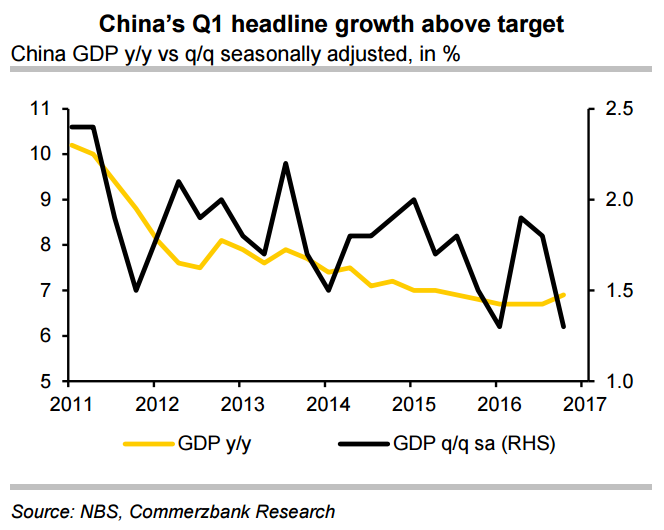
According to data published by the National Bureau of Statistics (NBS) on Monday, China’s Q1 2017 GDP grew by 6.9 percent y/y, beating forecasts for a 6.8 percent rise. On an annualized basis, China’s growth slowed it pace of expansion, coming in at 19 percent versus 1.7 percent last. Data showed China's policymakers leaned on infrastructure and real estate investment to drive expansion in the first quarter.
Credit surge likely fueled stronger investment and industrial activity. Despite efforts by authorities to crack down on debt risks, China's total social financing, a broad measure of credit and liquidity in the economy, reached a record 6.93 trillion yuan ($1 trillion) in the first quarter. Government spending rose 21 percent from a year earlier. Higher government infrastructure spending and persistent property boom helped boost industrial output by the most in over two years. Industrial production also rose to 6.8 percent y/y in Q1 2017, up from a 6.0 percent growth for 2016.
"The Chinese government has a tendency to rely on infrastructure development to sustain growth in the long term. The question we need to ask is whether this investment-led model is sustainable as the authorities have trouble taming credit. We need to watch closely whether China’s top leadership will send a stronger signal to tighten monetary policy shortly," economists at ANZ said in a note.
It is unlikely that the investment will remain elevated for long. As property prices have shown signs of overheating, tightening measures from the People's Bank of China (PBoC) will probably intensify in the coming quarters. As banks’ credit extension will likely slow down in the second half of this year, it follows that investment growth will have to moderate as a result.
"We think that the investment will unlikely remain elevated for long as property prices have peaked and credit growth is expected to slow down in the second half of this year. We believe that the overall growth trajectory will moderate over the next few quarters; therefore maintain our growth forecast at 6.5% for 2017. Meanwhile, CNY will continue to weaken, and USD-CNY is expected to reach 7.10 by the end of this year," said Commerzbank in a report.
Chinese yuan was trading almost flat despite robust industrial production and GDP data. USD/CNY made intraday high at 6.8840 and low at 6.8801 levels. PBOC sets Yuan mid-point at 6.8785/dollar vs last close 6.8855. FxWirePro's Hourly USD Spot Index was at -121.163 (Bearish), while Hourly CNY Spot Index was at 81.9024 (Bullish) at 1130 GMT. For more details on FxWirePro's Currency Strength Index, visit http://www.fxwirepro.com/currencyindex.







