


 US Inflation Expected to Ease in June, but Fed Rate Hike Risks Persist Amid Middle East Tensions
  FxWirePro: Daily Commodity Tracker - 21st March, 2022
  Asian Stocks Rise as Softer U.S. Inflation Boosts Sentiment Despite Middle East Tensions
  China Home Prices Fall Again in June Despite Slower Pace of Decline
  Asian Currencies Hold Steady as Middle East Tensions Offset Weaker US Dollar
  Asian Currencies Stay Rangebound as Middle East Tensions, Weak China GDP Weigh on Sentiment
  Asian Stocks Rally as Cooling U.S. Inflation Boosts Fed Rate Cut Hopes
  Best Gold Stocks to Buy Now: AABB, GOLD, GDX
  Port of Los Angeles Posts Record June Cargo Volume as Importers Rush Ahead of U.S. Tariffs
  China Q2 2026 GDP Misses Forecast as Weak Domestic Demand Offsets Export Strength
  Australia Consumer Sentiment Rises in July as Fuel Price Relief Lifts Confidence
  Oil Prices Surge as U.S.-Iran Conflict Escalates and Strait of Hormuz Risks Grow


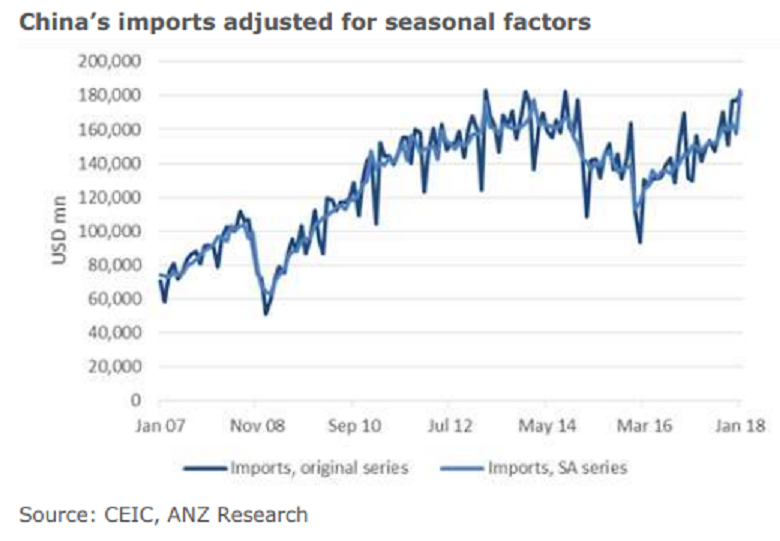
China’s booming imports are expected to conceal the near-term volatility, according to a recent report from ANZ Research. Seasonality, cold weather and higher commodity imports pushed up import growth in January. The timing of the Lunar New Year, which falls on different dates, and sometimes months, each year partly explains the surge in imports in January. After adjusting for seasonal factors, actual import growth is lower by around 10ppts.
At the same time, commodity imports rebounded in January, led by crude oil (up 19.6 percent y/y), coal (up 11.5 percent y/y), and iron ore (up 9.3 percent y/y) in volume against a colder winter. Higher commodity prices, especially imported oil prices which rose 13.8 percent y/y also account for the rise in commodity imports. Another big ticket item behind the boost in imports were mechanical and electrical products, which spiked more than 40 percent y/y, contributing more than half of the headline import growth.
The stronger-than-expected export growth suggests a continuous recovery in global demand. Exports to major markets including the US, EU, and ASEAN grew by 12.7 percent y/y, and 11.6 percent y/y and 20.5 percent y/y, respectively, which are in line with our view of recovering global demand. However, given the seasonal pattern surrounding the Lunar New Year, we may see more volatilities emerging in February and March.
"The uncertainty surrounding Sino-US trade ties remains a key potential downside risk in the near term. Despite a drop in the China-US trade surplus in January (to USD22 billion from USD26 billion prior), China’s near-term trade outlook might still be clouded by the escalation in tensions between the two countries," ANZ Research commented in its latest report.
Lastly, FxWirePro has launched Absolute Return Managed Program. For more details, visit http://www.fxwirepro.com/invest







