


 Asian Stocks Slide as Chip Shares Tumble Ahead of Key U.S. Jobs Report
  Japan Signals Surprise Yen Intervention Strategy as BOJ Hawkish Stance Puts FX Traders on Alert
  US Jobs Report Preview: June Payroll Growth Seen Slowing as Fed Rate Decision Looms
  Gold Surges Past $4150 on Dovish Fed Signals and Weak Jobs Data; Bullish Outlook Prevails
  South Korea Warns Won Is Undervalued, Boosts FX Coordination With Japan
  Elon Musk is remaking the world, like Henry Ford before him – but more dangerously
  Mary Daly Says AI Uncertainty Clouds Fed Rate Outlook Despite Restrictive Policy
  Asian Currencies Rise as Dollar Weakens; Yen Holds Steady Amid Japan Intervention Watch
  JPMorgan Cuts Gold Price Forecast, Sees Bullion Reaching $4,500 by End of 2026
  U.S. Dollar Drops as Weak Jobs Data Boosts Fed Pause Bets, Yen Jumps on Intervention Talk
  Denmark Central Bank Intervenes to Support Krone Peg Against Euro
  Goldman Sachs Raises USD/JPY Forecast, Sees Yen Weakness Persist Through 2027


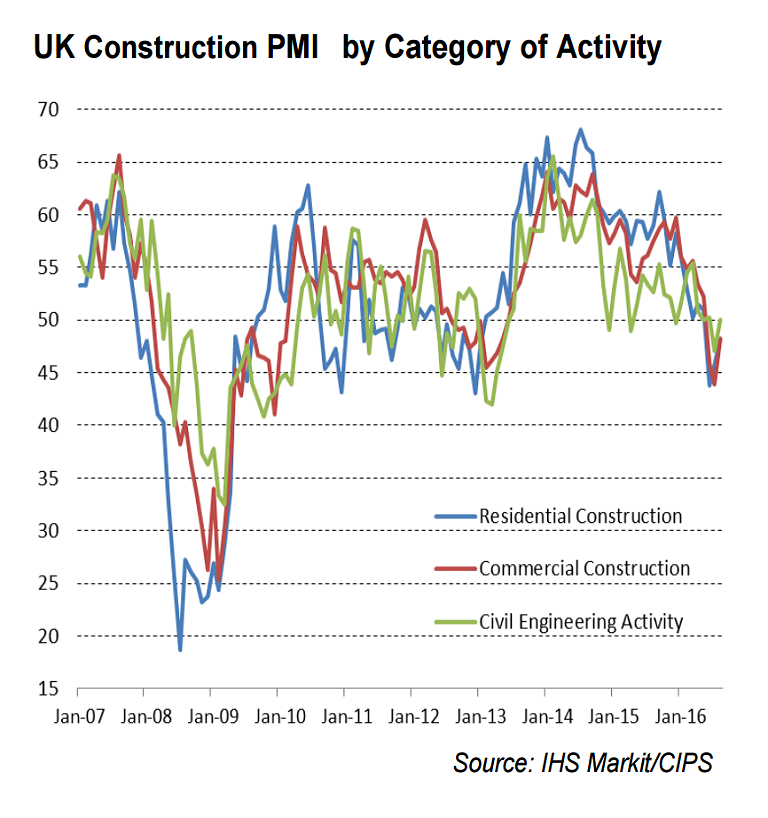
UK construction industry recovered more than expected in August, PMI data released earlier on Friday showed. The latest Markit/CIPS UK Construction Purchasing Managers' Index (PMI) rose to 49.2 in August from 45.9 in the previous month, beating forecasts at 46.1 in a Reuters poll. The overall construction activity, which accounts for about 6 percent of the economy - declined for a third straight month, remaining below the 50 mark dividing growth and contraction.
UK construction downturn that started just before June's vote to leave the European Union eased in August adding to signs the economy is stabilising. Looking ahead, construction firms pointed to a rebound in business confidence from July’s 39-month low.
Prices paid by construction firms for raw materials shot up at the fastest pace in just over five years, fuelled by the pound's plunge since Brexit. Also, manufacturing and services now reporting the highest rate of growth of input cost inflation for five years, as the weaker pound pushes up the cost of imported materials.
Tim Moore, senior economist at Markit and author of the Markit/CIPS Construction PMI, said: “The downturn in UK construction activity has eased considerably since July, primarily helped by a much slower decline in commercial building." However, the latest survey indicates only a partial move towards stabilisation, rather than a return to business as usual across the construction sector, Tim noted.
Today's data follows a surprisingly upbeat manufacturing PMI on Thursday, which showed that Britain's factories recorded activity of 53.3 in August, the highest level in 10-months and a huge acceleration from July's reading. The headline reading also represented the joint highest single monthly gain since the PMI survey began 25 years ago, jumping from 48.3, a 41-month low, in July. Consumer confidence also recovered somewhat last month after taking a huge plunge in July, according to market researchers GfK.
The Bank of England took action in early August to restore confidence among businesses and households and ward off a recession. It cut interest rates to a new record low of 0.25 percent and expanded its programme of bond purchases. Upbeat data could prompt the Bank of England to rethink the need to cut interest rates again.
"August’s construction and manufacturing PMIs provide encouraging news that any immediate hit to the economy from the uncertainty caused by the EU referendum may be more limited that previously feared,” said Chris Williamson, Chief Economist, Markit.
After hitting a 4-week high level of 1.3318 on Thursday following stellar manufacturing PMI data, GBP/USD seeing some profit taking ahead of the keenly watched US monthly jobs report. Trades largely unchanged on the day at around 1.3271 at around 12:00 GMT.







