


 Japan Signals Preference for Low Interest Rates as BOJ Policy Debate Intensifies
  South Korea’s KOSPI Jumps Over 5% as Samsung, SK Hynix Rally on Micron Earnings Boost
  Oil Prices Drop as Middle East Supply Recovery Eases Market Concerns
  Australian Household Spending Rebounds Strongly in May as Travel and Dining Drive Consumer Growth
  Oil Prices Drop as Strait of Hormuz Shipping Recovers
  Bessent Says U.S. Must Strengthen Supply Chains and Economic Security
  Iran Attack in Strait of Hormuz Pushes Oil Prices Higher
  BOJ Hawk Signals Faster Interest Rate Hikes Amid Inflation Risks


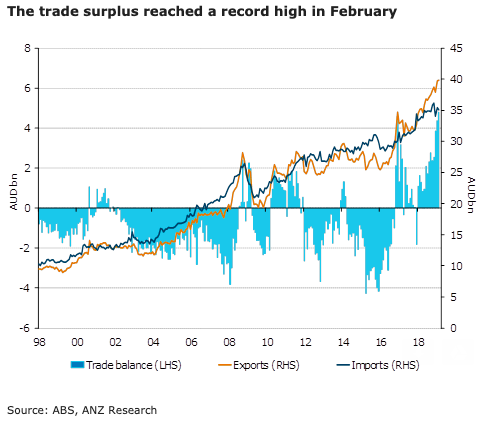
Australia’s trade balance improved in February to a record surplus, following January’s strong surplus. Underlying this were broadly steady exports, with a rise in iron ore offsetting a decline in coal.
A decline in imports was largely due to lower fuel imports, likely reflecting price effects. After surging in January, exports of non-monetary gold did not retreat significantly in February.
The monthly trade balance improved to a surplus of AUD4,801 million in February. Underlying this was a 1 percent fall in imports, while exports were broadly flat in the month.
Resource exports rose 11.4 percent in the month, as an 11.1 percent increase in metal ores and minerals offset a 12.7 percent decline in coal. Rural goods fell 1.1 percent, led by 6.1 percent declines in both cereals and wool. Manufacturing exports fell 3.2 percent, due to a 27 percent fall in transport equipment. Service exports rose 1.7 percent as travel increased 2.2 percent.
Imports intermediate and other merchandise goods fell 4 percent m/m, largely due to a 10.7 percent decline in fuel imports. Imports of capital goods declined 2.3 percent m/m as telecommunications equipment fell 6.2 percent and civil aircraft declined 19.3 percent.
Meanwhile, consumption goods imports rose 0.1 percent, despite an 18.4 percent surge in car imports. Service imports rose 2.8 percent, reflecting a 4.4 percent rise in travel.







