


 Australia Jobs Fall 39,300 as Unemployment Hits 4.7%
  Italy’s Meloni Warns US-Russia Diesel Deal Could Weaken Ukraine Sanctions
  Container Ship Sinks in Strait of Hormuz as Iran Attacks Escalate
  Wall Street Closes Lower as Bank Earnings and AI Concerns Weigh
  Best Gold Stocks to Buy Now: AABB, GOLD, GDX
  FxWirePro: Daily Commodity Tracker - 21st March, 2022
  Gold Prices Mixed Ahead of US Inflation Data and Fed Rate Outlook
  China Resumes US Soybean Purchases After Trump-Xi Summit


 Add as a preferred source on Google
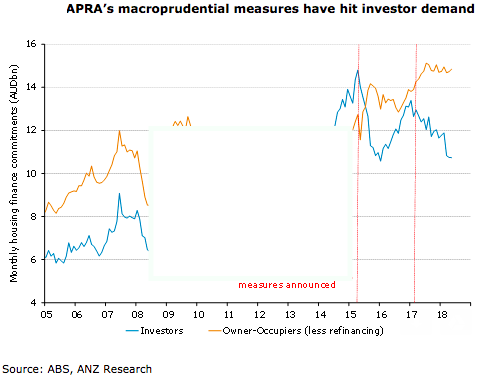
After falling quite heavily in recent months, Australia’s housing finance commitments posted a small rise in May. The investor segment contracted further, continuing the weakness in the wake of APRA’s macro-prudential policy changes.
The value of Australian housing finance commitments rose slightly in May, but not by enough to offset recent weakness. The value of monthly approvals is more than five per cent lower than a year ago. Investors are the main driver of this weakness, edging down another 0.1 percent m/m, while the owner-occupier segment is performing better (0.8 percent m/m).
The fall in investor demand is clearly related to APRA’s macro-prudential policies. In 2015, the 10 percent speed limit on investor borrowing saw a sharp drop in the presence of investors, and the subsequent limit on interest only loans in 2017 has had a similar impact.
Even the removal of the 10 percent growth limit, announced at the end of April 2018, is unlikely to drive renewed strength. As a result, the share of new lending going toward investors is at the lowest level in several years.
"A central feature of our view on the housing market is that credit conditions continue to tighten through the remainder of 2018. This is expected to result in further weakness in housing finance going forward, which will in turn weigh on housing prices and building approvals," ANZ Research commented in its latest report.







