


 Gold's Tug-of-War: Geopolitical De-escalation Fights Falling Yields as Markets Eye US CPI
  Cardano Price Drops 15% as Whales Sell 110 Million ADA
  UK Finance Minister Healey Calls for Fiscal Discipline Amid Global Risks
  US Dollar Index Falls as Fed Signals Caution, Indian Rupee Surges
  Bank of America Predicts Yen Rebound as USD/JPY Faces Risks
  Fed's Hammack Urges Faster Rate Hikes to Fight Inflation
  Arthur Hayes Announces FLOP Testnet Launch Within Weeks
  Asian Currencies Steady as Dollar Nears 18-Month High Ahead of US CPI
  RBI Rate Hike Bets Surge as Inflation Rises
  US Stock Futures Rise as Oil Prices Fall Ahead of Q3 Earnings
  Oil Prices Fall as Russia Signals Higher Diesel Exports
  Crypto Derivatives Dashboard: Bulls Retain Control Amid $488M Liquidation Flush
  RBA Signals More Rate Hikes as Inflation Risks Rise
  Ripple-Backed Evernorth Set for Nasdaq Debut With 473 Million XRP
  Oil Prices Surge Above $106 After Deadly Saudi Airport Attack


 Add as a preferred source on Google
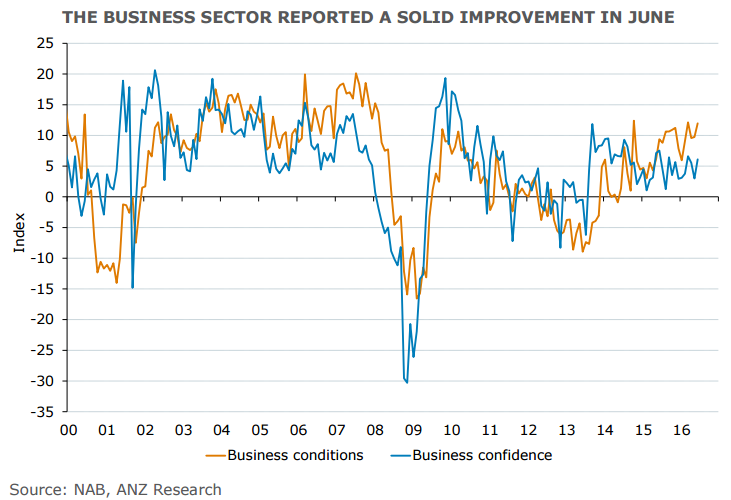
NAB’s closely-watched business survey for June tested the sentiment of local firms amidst the uncertainty of the federal election as well as the political unease in Europe and consequent market turbulence. The NAB business confidence index rose to 6.0 in May from 3.0 in the previous month. The index measuring forward orders and capital expenditure both improved during June. Business conditions also lifted from their already elevated level to +12 index points from +10 in the previous month.
The rise in business conditions was due to a notable improvement in employment demand, although profitability also rose, while trading conditions were unchanged at very elevated levels. Employment conditions are now back above long-run average levels, suggesting solid near-term employment growth. The results point to further improvement in the non-mining economy in Q2, with growth potentially becoming more broad-based.
“This suggests that firms are looking through external uncertainties, choosing to focus on the positives they see in their own business, at least for the time being,” NAB chief economist Alan Oster said.
The RBA should be reasonably comfortable with the present state of economic conditions and also the resilience of business confidence and business conditions in the wake of recent events that cloud the outlook. That said, inflation measures in the survey were broadly steady, although a drop in retail prices may have implications for CPI. Lacklustre views on inflation point to an opportunity for the Reserve Bank to further cut record low rates later this year.
Australia's inflation fell to multi-year low in Q1. In the first quarter of 2016, consumer prices fell 0.2% over the previous quarter, undershooting market analysts' expectations of a 0.3% increase and contrasting Q4 2015's 0.4% increase. NAB considers the report a mixed bag for the Reserve Bank to digest, with the lack of inflationary pressure leaving the door open to an August rate cut despite signs of robust economic growth.
“These trends justify the highly accommodative setting for monetary policy, but while the August RBA meeting (post Q2 CPI) is likely to be ‘live’, current information suggest rates will remain on hold — although it is likely to be a close call,” NAB said.
Aussie buoyed by robust data. AUD/USD hits new 2-week highs at 0.7637. Technicals support upside in the pair. The pair finds next hurdles at 0.7647 (June 24 high) and then at 0.7687 (78.6% Fib of 0.7835 to 0.7145 fall).







