


 Gold Prices Mixed as Stronger Dollar Offsets Safe-Haven Demand Amid U.S.-Iran Peace Talks
  Oil Prices Slip as Iran Sanctions Relief and Hormuz Shipping Recovery Ease Supply Concerns
  Trump Requests $11 Billion More in Farm Aid as Rising Costs Pressure U.S. Farmers
  Japan Keeps Markets Guessing as Yen Nears 40-Year Low, Raising Intervention Risks
  Bessent Says U.S. Must Strengthen Supply Chains and Economic Security
  Australia Inflation Cools in May, But Core CPI Keeps RBA Rate Hike Risks Alive
  Malaysia Central Bank Moves to Support Ringgit Amid Foreign Fund Outflows
  Asian Stocks Slide as AI Rally Pauses, South Korean Chipmakers Lead Regional Decline
  U.S.-Iran Diplomacy Helps Drive Gasoline Prices Down 15% From May Highs
  US Dollar Hits One-Year High as Hawkish Fed Outlook Overshadows Middle East Developments


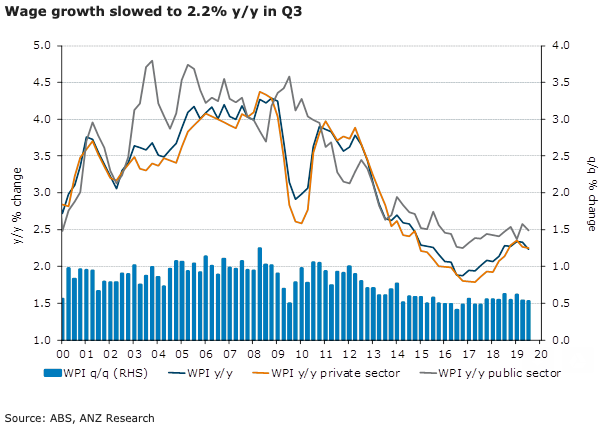
Australia’s wage price index (WPI) rose by 0.5% q/q in Q3 2019, slowing annual growth to 2.2%. With the Q2 result inflated by a significant, one-off increase in Victorian public sector health wages, the Q3 result is seen to be more reflective of the rise in labour market underutilisation since early 2019, along with the deterioration in enterprise bargaining agreement (EBA) wage increases since late 2018.
The slowdown in wage growth is not unexpected, but it will put further pressure on household incomes.
The private sector maintained quarterly growth at 0.5 percent, but this wasn’t enough to prevent annual growth slipping to 2.2 percent, down from 2.4 percent in Q1. However, including bonuses, private sector wage growth jumped to 2.9 percent y/y. This effectively reversed the prior quarter’s fall, and we don’t think it points to an upward shift in wage outcomes.
Public sector wage growth dropped back to 0.5 percent q/q. This followed a very strong 0.8 percent q/q result in Q2, which was inflated by a significant, one-off increase for Victorian public sector nurses and midwives to achieve parity with New South Wales. Annual growth in public wages slowed to 2.5 percent.
Most industries saw annual wage growth slow in Q3, with the largest decline in other services (-0.4ppt). Transport (+0.2ppt) and professional services (+0.1ppt) were among the few that saw improvement. Annual wage growth in construction and retail was unchanged during the quarter.
Victoria maintains the strongest wage growth in the country at 2.8 percent y/y, followed by the ACT (2.5 percent y/y). While some economic indicators have been showing recent positive signs for Western Australia, this doesn’t appear to be flowing through to wages yet, with growth still at 1.6 percent y/y.







