


 Gold Price Holds Near Record High as Cooling U.S. Inflation Offsets Fed Caution
  Australia Consumer Sentiment Rises in July as Fuel Price Relief Lifts Confidence
  South Korea Central Bank Set to Raise Interest Rates as Inflation Stays Elevated
  Oil Prices Climb as Trump Escalates Iran Pressure, Strait of Hormuz Risks Grow
  Singapore GDP Grows 5.7% in Q2 2026 as AI-Driven Manufacturing Boosts Economy
  Dollar Eases as Middle East Conflict, Fed Outlook and Japan Pension Policy Drive FX Markets
  Gold Prices Fall as US-Iran Conflict, Rising Oil Prices Fuel Fed Rate Concerns
  Asian Currencies Weaken as Stronger Dollar Weighs, Yen Supported by GPIF Repatriation Hopes
  Dollar Holds Steady Ahead of U.S. CPI as Oil Surge, Middle East Tensions Keep Markets on Edge


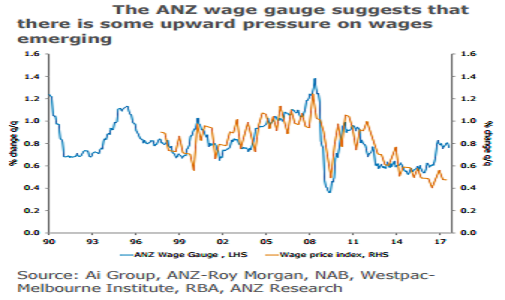
The Australian wage growth is expected to creep higher over the coming years as spare capacity in the labour market is gradually being eroded, job insecurity has fallen, and businesses are reporting some pockets of difficulty in finding suitable labour, ANZ Research reported.
The RBA would also have been disappointed by the today’s weak results. The Bank has expressed confidence on a number of occasions that wage growth would improve, but that confidence will be tested by the weakness apparent in these numbers. Ongoing very-low wage growth and its implications for both the consumption and inflation trajectory suggest that monetary policy is likely to remain stimulatory for some time.
The wage price index (WPI) rose by just 0.5 percent q/q in Q3 and is up 2.0 percent over the year. This was significantly weaker than market expectations and below our own forecasts. Both private and public sector wages rose 0.5 percent q/q.
The soft result was also shown in the industry breakdown. Even some industries which would have a high proportion of award workers (whose wages would have been boosted by the minimum wage), annual growth in wages slowed. The retail sector, for example, saw wage growth slow from 1.8 percent y/y in Q2 to 1.6 percent in Q3.
FxWirePro launches Absolute Return Managed Program. For more details, visit http://www.fxwirepro.com/invest







