


 Asian Currencies Hold Steady as Middle East Tensions Offset Weaker US Dollar
  Australian Business Conditions Hold Steady as Easing Cost Pressures Face New Oil Price Risks
  Asian Stocks Slide as Oil Surge, U.S.-Iran Tensions and Fed Rate Bets Weigh on Markets
  Asian Currencies Stay Rangebound as Middle East Tensions, Weak China GDP Weigh on Sentiment
  South Korea’s KOSPI Enters Bear Market Despite Remaining 2026’s Best-Performing Major Stock Index
  Goldman Sees Foreign Investors Driving India Stock Market Recovery
  Best Gold Stocks to Buy Now: AABB, GOLD, GDX
  ECB's Kocher Says No Inflation Spillover Yet From Iran Conflict, Warns Risks Remain
  Port of Los Angeles Posts Record June Cargo Volume as Importers Rush Ahead of U.S. Tariffs
  Oil Prices Rise as U.S. Strikes on Iran Raise Strait of Hormuz Supply Fears
  Gold Prices Slip as Oil Rally Fuels Inflation Fears, Strengthens Dollar
  Asian Stocks Slide as Chip Selloff Deepens Ahead of TSMC Earnings


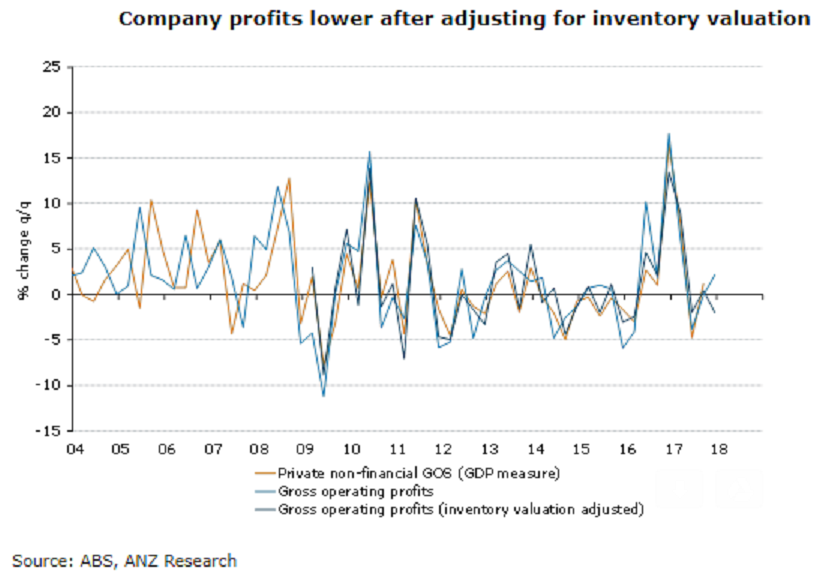
Australia’s fourth-quarter business indicators data came in weaker than market expectations, with profits, wages and inventories all coming in below consensus estimates. These numbers provide some downside bias to the estimate in the Q4 gross domestic product (GDP), due for release on Wednesday, ANZ Research reported.
Company profits posted a solid headline rise (+2.2 percent q/q) in Q4 following a modest decline of 0.1 percent q/q. After adjusting for inventory valuations the result was much weaker, however, with profits actually falling 2.4 percent q/q.
Non-mining profits rose 1.2 percent q/q to be 5.8 percent higher than a year ago. While this is a solid result, the buoyancy in business conditions and profitability indicators would have suggested a stronger result. By industry, the numbers are volatile quarter to quarter, but in terms of annual growth, the areas of strength are administrative services, utilities, wholesale trade, and finance.
"Conversely, one of the weakest sectors is construction, which seems surprising given the strength in activity. We expect that non-mining profits will continue to strengthen given ongoing elevated business conditions. Mining profits rose 4.2 percent q/q, with commodity prices relatively flat in Q4" the report added.
Growth in the wages bill was solid, although not as strong as was expected. It rose 1.0 percent q/q, following a 1.3 percent rise in Q3 (upwardly revised from +1.1 percent), bringing annual growth up to 4.3 percent. The wages bill is being supported by strong growth in employment and further gains should support growth in household incomes and consumption.
Lastly, FxWirePro has launched Absolute Return Managed Program. For more details, visit http://www.fxwirepro.com/invest







