


 Gold Prices Fall Amid Rate Jitters; Copper Steady as China Stimulus Eyed
  Australian Household Spending Rebounds Strongly in May as Travel and Dining Drive Consumer Growth
  Wall Street Ends Lower as AI Stocks Drag Markets, Fed Rate Outlook Shifts
  Best Gold Stocks to Buy Now: AABB, GOLD, GDX
  SpaceX Eyes Starlink Mobile Phone Service to Challenge Verizon, AT&T, and T-Mobile
  Trump Requests $11 Billion More in Farm Aid as Rising Costs Pressure U.S. Farmers
  Oil Prices Drop as Strait of Hormuz Shipping Recovers
  Wall Street Ends Mixed as Micron Surges, Apple Drops After Price Hikes
  Asian Markets Rally as Micron and Qualcomm AI Outlook Lifts Global Tech Stocks
  Australia Jobs Growth Strengthens Rate Hike Outlook
  South Korea’s KOSPI Jumps Over 5% as Samsung, SK Hynix Rally on Micron Earnings Boost
  BOJ Hawk Signals Faster Interest Rate Hikes Amid Inflation Risks
  White House Seeks $87.6 Billion Emergency Funding for Iran War, Farmers, and Ebola Response


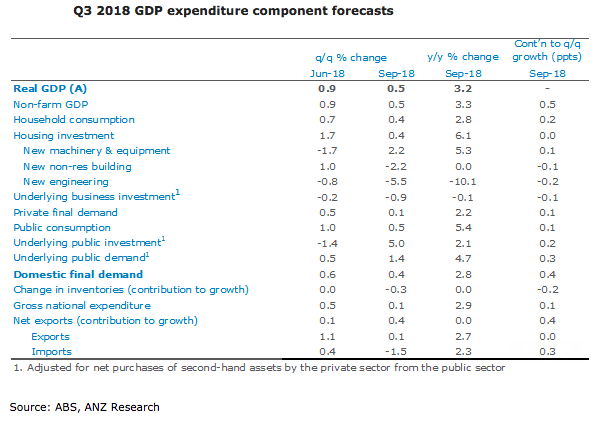
Australia’s gross domestic product (GDP) for the third quarter of this year is expected to have risen a relatively modest 0.5 percent q/q, following a gains of 1.1 percent and 0.9 percent in Q1 and Q2 respectively. This would see annual growth edge down to 3.2 percent.
At +0.5 percent q/q and +3.2 percent y/y, GDP growth looks to have been a little lower than the RBA expected. A step up to 0.9 percent q/q in Q4 would be required to achieve the 3-1/2 percent forecast for Dec 2018.
In tomorrow's report, the focus is likely once again to be on the household indicators - consumption and wages. Weak retail sales volumes (+0.2 percent) and car sales suggest a softer outcome for Q3 consumer spending.
Preliminary data from the business indicators report suggest that was likely to have been soft, with annual growth likely to have decelerated. The combination of weaker consumption and disappointing wages growth if confirmed in the GDP report would be a concern.
The RBA has so far been able to play down the implications of falling house prices, with the view that stronger growth in household income would provide enough support to consumer spending. But with house price weakness accelerating, wages slow to pick up and consumption softening, the outlook may not be so rosy.







